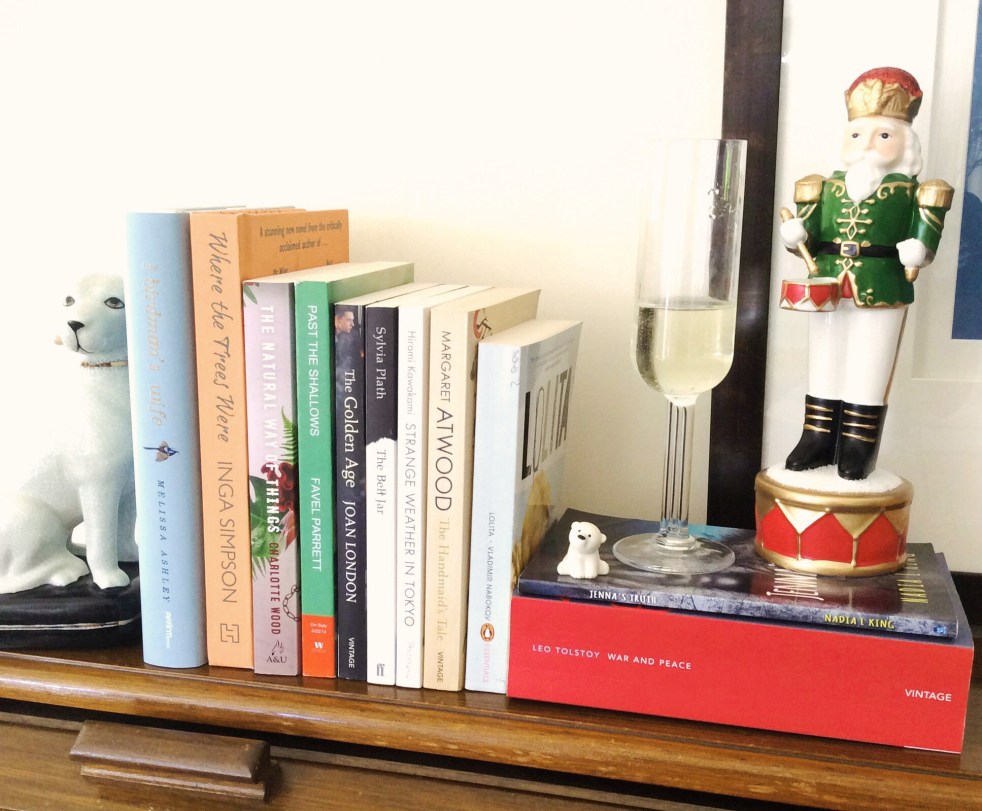
Nadia L King, a Perth writer, promoter, reviewer and all-round wonder, highlights some of her favourite reads in 2016.
Month: Dec 2016

When you gonna’ make up your mind?
 My neighbours are on their veranda, clearing plates and talking, after sharing dinner with their extended family. My kids are staying with their grandparents, to give me 24 hours to myself before the Xmas crazy begins. Ariel, our cat, slinks about my legs as I sit outside, smoking and typing in the dark, listening to dogs barking, cars in the distance.
It’s been a funny old year and I’m still catching up to the experiences I’ve had. To the interior resources I’ve needed to draw upon, to the unexpected joy and pleasure I’ve discovered in public speaking. (I’ve suffered from and wasted far too many years with severe social anxiety.) I’m not good at holidays, and when the frenzy of work stops, I find myself a little lost and discombobulated.
There is every reason for me to have an easy Xmas in a few days, and yet I find myself shadowed by the Decembers of the past two years. In 2014, the life of my family was irrevocably changed by my daughter’s diagnosis of cone-rod dystrophy, a retinal degenerative disease. Cone-rod dystrophy is rare, 1 in 40,000 people have the faulty gene or genes and the pathway of its causation can be hereditary or by spontaneous mutation. Because there is no history of the disorder on either side of our family, my daughter’s diagnosis was a profoundly shocking and distressing experience.
I wonder if it is okay to write about this, about how I feel, about my daughter’s vulnerability. 2016 has been a difficult year for her, particularly with her education; she is legally blind and needs aides, technology, teacher support and other resources to access written texts. English, history, and science are engaged with using text to speech technology; maths is a nightmare – it is exceedingly difficult to see decimal points and symbols with a loss of central vision. So difficult that she has not been assessed in several subjects. Some sports are okay – swimming, running with a buddy – but others, particularly those that use a ball, are frightening; loss of central vision results in the inability to track a moving object properly.
That said, my daughter has excellent mobility; indeed, people often comment to me that she seems perfectly fine. Severe low vision, without the markers of a guide dog or cane, can be something of an invisible illness. And I think this is where she struggles, as she wants to be just like everyone else, to fit in, and strangers, teachers, peers and even family sometimes express opinions that are frustrating, in their attempts to help or reassure. Suggesting that the ways she has learned to navigate are less difficult and extraordinary than they really are.
My daughter is in fact, an incredibly resilient, courageous, intelligent, feisty and perceptive pre-teen. She has recently adopted an all-black wardrobe, which she calls ‘emo’ – I get into trouble when I accidentally call her a goth. I have allowed her to dye her hair black, and even wear eye-liner when we visit friends, ignoring funny looks from people, because this is a persona she has created to help her identify positively with being different.
Where, as a mother I might be concerned about how much time she spends in front of the mirror, instead I put it to one side and help her. Try not to make an issue of it. Because she needs to look at herself using her peripheral vision, she cannot form a clear picture of her own face, and who am I to deprive her of this fundamental relationship with herself, especially in that her condition is degenerative?
There is much hope for the future, with retinal implants, and it is very likely she will, hopefully sooner than later, have her sight restored one day. We keep that at the back of our thoughts and focus on the now.
Unfortunately, as a single parent and arts worker, and I wonder if I am entering taboo territory here, I have found my role of supporting her very difficult at times. The devastation of her diagnosis triggered a severe breakdown in December 2014 and I now have a mental illness which needs managing with a handful of twice-daily medications. Which I cannot see myself weaning off any time soon: while 2016 has been one of the happiest years of my life, it has also been one of the saddest. Our little family could not hold together through the strain of being writers, workers, parents and partners. A year ago, almost to the day, my husband and I separated.
As I come through the end of 2016, where I have probably alienated half of my friends by over-posting the recognition my first novel has received on Facebook, I can reflect a little about why I did this. I think, in the grip of emotional devastation, both mine and others, I held out these little gems of achievement? recognition? hope? – to keep an important part of my identity intact, while the rest of me fought to survive.
I read an article recently (I remember neither the author nor the source, or was it listening to a conversation on radio national?), about living past trauma, integrating major life change. The speaker – it was radio national – a psychologist, challenged the notion that we ‘get over’ a situation in which everything we had thought made up our lives and selves shatters. When we have to adapt to circumstances using our physical, mental and emotional capabilities in ways we had not imagined were possible.
It is okay, the woman explained, to just get through. ‘Just,’ in itself, can be sufficient. To keep getting out of bed, to keep moving though we feel reduced, unravelled, in shards. That for many, it is never the case of ‘triumph over tragedy’, that narrative our media likes to recycle for exceptional transformation. For the rest us, such an expectation can be psychologically detrimental.
I guess what I’m trying to remind myself is that, while the determination and ‘strength’ I thought I had, that I once built my identity around, seems to have up and left for good, that’s sort of inevitable. And it may seem obvious, but it’s an awareness and an acceptance that I need to keep reminding myself of, lest I create a schism of self-pity or victimisation between then and now. Lest I get ‘sick’ again.
On another level, I’m attempting to give myself permission to recognise that cliche, ‘things change’ which Tori Amos so beautifully opened and released in the song Winter.
Already 2017 is full of challenges. My daughter is starting high school. I am a single parent. I am a writer, and thus, financial security, particularly long-term, is something that I have pretty much sacrificed to the altar of the craft I committed to mastering some 20 years ago. I have a writing schedule that will require spells and alchemy, thankfully writing provides that once and a while, to fulfill.
Right now, anticipating the new year and its looming demands makes me grit my teeth, makes my stomach clench, cold and metallic. Will I cope? Will this be my undoing? The threat, if you have a mental illness, is that an experience, a period of prolonged stress and over work, will tip you out of remission. Skid you back down the rabbit hole into the tank of isolation which, in my experience, is one of the most devastating outcomes of active mental illness. The utter disconnection from others, the complete withdrawal into a dis-eased self, that without treatment, without argument, only expands, pulling all meaning down with it.
While I was recovering from my ‘breakdown,’ I watched an extraordinary Ted Talk. The topic was stress, and yet I think it can be applied to recovering from, adapting to, major life change. The upside of being overwhelmed, or not being able to manage intense emotion, is that we are actually adapted to reach out to other people, and that there are rewards, built into our physiology and psychology for doing so. We were never meant to muddle through alone.
I’m sure this observation goes without saying to many people, but not so much those in the grip of active and / or chronic mental illness. We need to be reminded that opening up to, admitting to, sharing and speaking up about our losses and confusion and states of overwhelm, is (in) our nature. As a species, we have evolved to tackle adversity in groups. Our long socialisation as infants lays down deep wiring that requires the warmth of another’s voice, the touch of another’s hand, an exchange of eye contact, to release oxytocin, the bonding hormone that helps to secure our attachments – to infants, lovers, friends. Oxytocin produces the feeling of love: connection, warmth, comfort, belonging, relief. In other words, oxytocin is our reward for being open to other people, for being alive.
I came across a meme once that described depression (the same might be said of anxiety) as a bully who abuses and beats you until you’re a bruised mess curled in a corner, unable to stand. By this I mean that mental illness has a terrible capacity to seduce and manipulate you into identifying with it, no matter the disorder. I find this observation of the bully immensely helpful. It gave me a little ‘haiku’ moment, a flash of recognition as I visualised the aggressor depression separated from the shell of the self.
But mental illness, in whatever guise, is not the summation of who you are. No matter how cosy it may feel snuggling up to the silky black pup of depression or tying to outwit the avenging disciplinarian of anxiety.
Isolation, for that is the root devastation of mental illness, is so damaging because one’s perspective becomes severely distorted without input from other people. Speaking out about your experiences is not some mere distraction from a ‘bad mood,’ is not whinging, is not burdening others. Rather, it can lead to renewed belonging, a sense of inclusion, and sometimes, with the right listeners, an understanding of the particulars of our unique struggles. Relationships with others and the positives that stem from safe, interpersonal exchanges are our birthright as human beings.
I should not have to reiterate the point, to myself, to others vulnerable to debilitating anxiety, depression and other mental illness, that we should try to not isolate during what can be a very confronting time of year. If we dare enough, we can close our eyes and reach out this Christmas.
For information and help with mental illness:
Lifeline: 13 11 14

The Birdman’s Wife longlisting Indie Awards 2017: debut novel
 The year 2016 has been the most topsy-turvy of my forty-three years. I will probably write a memoir about it in ten years’ time. So much going on personally that I am still digesting. Which is why the launch of my first novel, The Birdman’s Wife has brought me such joy. I’m humbled, honoured and more than a little bit excited that The Birdman’s Wife, the story of Elizabeth Gould, the pioneering 19th century ornithological illustrator and wife of John Gould, the ‘birdman’ has been received with such warm and open arms.
The Birdman’s Wife has been long-listed for the Indie Booksellers’ 2017 Book Awards, in the debut fiction category, with a host of excellent Australian first-time fiction authors. I had the pleasure to feature on a panel in the Newtown Festival’s writers’ tent with the down-to-earth Holly Throsby, author of Goodwood and the entertaining Liam Peiper, author of The Toymaker, whose books have both shortlisted in the same category. They sat to my left, and to my right sat the gracious Sean Rabin, who like me, has had a double-decade journey to publishing his first novel: Wood Green. And it’s all worth it, Wood Green has been shortlisted for the Victorian Premier’s Literary Awards.
Thanks to everyone on my team who made The Birdman’s Wife happen: Bronwyn Lea, Melissa Harper, Carole Ferrier, Lyn Tranter, Fiona Henderson, Martin Hughes, Ruby Ashby-Orr, Emma Rusher, Vikki Lambert, Inga Simpson, Avid Reader and Brett Dionysius, for your expertise and faith. It’s been an incredible team effort!
I’m finally in the space, mentally, after a whirl-wind two months, to dive into my new project, an historical novel loosely based on the scandalous life of Marie Catherine d’Aulnoy, a 17th century author of fairy tales, memoir, fiction and novels. But first I’m going to enjoy a week’s holiday with my family at Coolum beach.
Enjoy the year’s wind down everyone; I’m looking forward to an exciting 2017, filled to bursting with scintillating reading and frustrating and ecstatic writing.
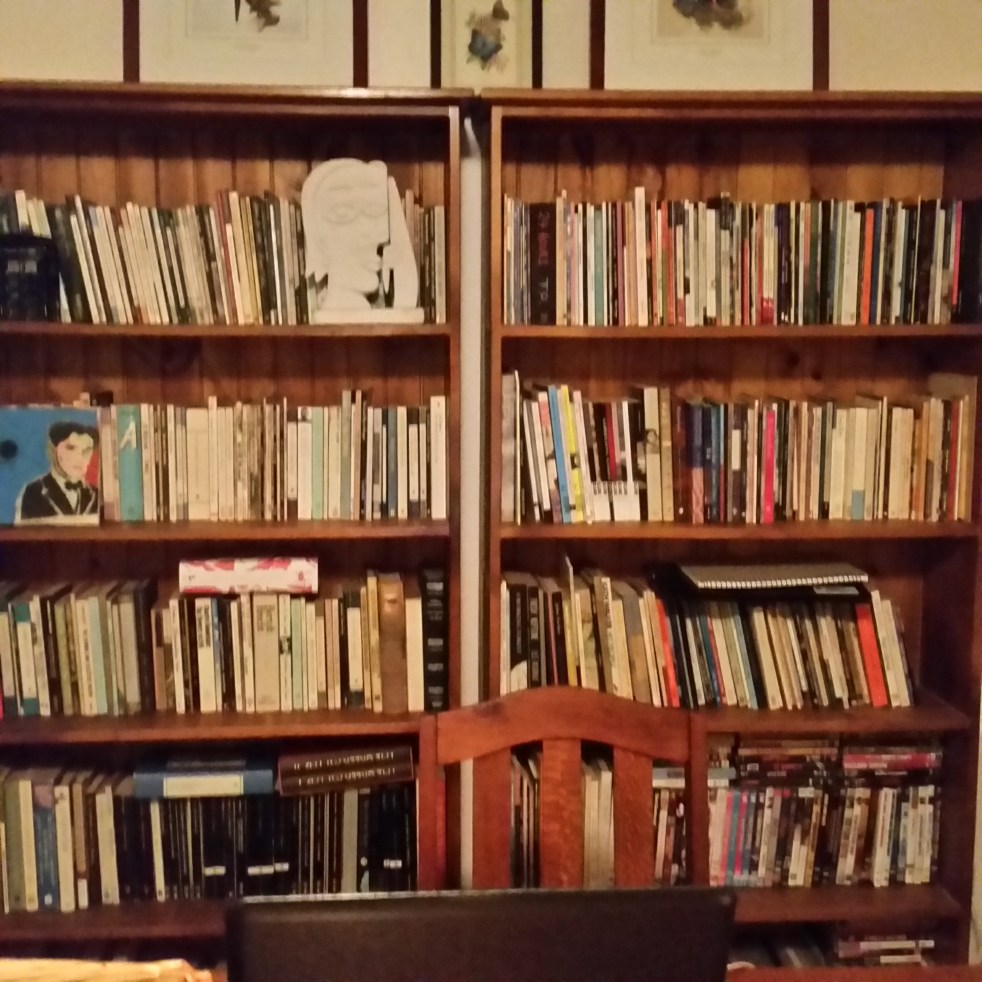
My Favourite Reads: 2016
Books that blew me away in 2016, in no particular order:
Eileen by Otessa Mosfegh
Being Grace by Antony Doer
All My Puny Sorrows by Miriam Toews
Dying in the First Person by Nike Sulway
Arcadia by Lauren Groff
My Name is Lucy Barton by Elizabeth Strout
Where the Trees Were by Inga Simpson
The Toy Maker by Liam Pieper
The Promise Seed by Cass Moriarty
Station Eleven by Emily St John Mandel
Perfume by Patrick Suskind
An Untamed State by Roxane Gay
Mullumbimby by Melissa Lukashenko
Love and Louis XIV by Antonia Fraser
Madness by Kate Richards
Drinking: A Love Story by Caroline Knapp
Wasted by Elispeth Muir
Blackout by Sarah Hepola
The Blindfold by Siri Hustvelt
Under the Ivy: A Biography of Kate Bush by Graeme Thomson
Miss Smilla’s Feeling for Snow by Peter Hoeg
Dangerous Liaisons by Pierre Choderlos de Laclos
A Thousand Orange Trees by Kathryn Harrison
Speak, Memory by Vlamdir Nobakov
The Hazards by Sarah Holland-Batt
The Inheritance of Loss by Anita Dessai
Margaret the First by Danielle Dutton
Wonder Tales Ed. Marina Warner
Loud in the House of Myself by Staci Pershall
A Mood Apart: The Thinker’s Guide to Emotions and its Disorders by Peter C. Whybrow
The Biology of Desire by Marc Lewis
The Wallcreeper by Nell Zink
An Unquiet Mind: A Memoir of Moods and Madness by Kay Redfield Jamison
The Quiet Room: A Journey out of the Torment of Madness by Lori Schiller
The Chronology of Water by Lidia Yuknavitch
Wasted by Myra Hornbach
Madness by Myra Hornbach
 Melissa Ashley