Review

Samantha Brennan reviews The Bee and the Orange Tree

20120804-110811[1]Why I had to pick it up

That blurb!

Okay, let me go back a little…

Right now, I’m wrists-deep in metaphorical ink, writing and plotting my middle-grade fantasy series Stella Duke and the Sandgirl’s Curse. The history and politics of the magical world I’m painstakingly building have their beginnings in French author Charles Perrault’s 1697 version of Cinderella, the first iteration of the tale to feature a fairy godmother. I tell you this fun fact to explain why this period in literary history—the time of the first fairy tales—was pinging on my authorial radar.

Enter: The Bee and the Orange Tree and that blurb!

Promising to reveal the life of Marie Catherine d’Aulnoy, the seventeenth-century author who invented what would become modern-day fairy tales, the back cover appealed to my professional curiosity as well as my penchant for any story that puts strong women front and centre. I just had to know more about this time in our literary history as well as the impressive, mysterious woman who created a genre.

comtesse_mailly_1698
Why I couldn’t put it down

Melissa Ashley nails the monumental task of creating a piece of historical fiction that embodies the character and personality of an era while also engaging the contemporary reader. She does it with well-defined language, spellbinding imagery and super-tight dialogue; Melissa herself says it’s a balance that required multiple drafts to get right.

Not only did I enjoy the foray into the seventeenth-century literary circles, where fierce creative women—otherwise oppressed by government, church and men—came together to support each other through story and social convention, but I was captivated by the lives of the story’s three main characters. I couldn’t get enough of the insights into literary salons and old-world publishing, and I couldn’t look away from these characters until their destinies were finally revealed.

Why writers will want to read it

The Bee and the Orange Tree is a beautiful book with a strong, distinctive voice, making it a must-read novel for writers of all fiction, historical or otherwise. Falling in love with this book was a dual experience for me. As a reader, I was consumed by the world-building—the characters, the plot, the tension… As a writer, I was struck over and over again by the voice, the art and the stamina. More than once, lost in the story-telling, I stopped short at a particular paragraph or turn of phrase and had to read it twice or more again, just to marvel at the craftsmanship. And Melissa does not drop the ball once—the writing is solid and striking until the very last page.

Reposted from http://wordsbysamanthabrennan.com/blog-book-love-the-bee-and-the-orange-tree-by-melissa-ashley/
Review

Book Review: The Bee and the Orange Tree by Melissa Ashley

The Bee and the Orange Tree…

About the Book:

It’s 1699, and the salons of Paris are bursting with the creative energy of fierce, independent-minded women. But outside those doors, the patriarchal forces of Louis XIV and the Catholic Church are moving to curb their freedoms. In this battle for equality, Baroness Marie Catherine D’Aulnoy invents a powerful weapon: ‘fairy tales’.

When Marie Catherine’s daughter, Angelina, arrives in Paris for the first time, she is swept up in the glamour and sensuality of the city, where a woman may live outside the confines of the church or marriage. But this is a fragile freedom, as she discovers when Marie Catherine’s close friend Nicola Tiquet is arrested, accused of conspiring to murder her abusive husband. In the race to rescue Nicola, illusions will be shattered and dark secrets revealed as all three women learn how far they will go to preserve their liberty in a society determined to control them.

This keenly-awaited second book from Melissa Ashley, author of The Birdman’s Wife, restores another remarkable, little-known woman to her rightful place in history, revealing the dissent hidden beneath the whimsical surfaces of Marie Catherine’s fairy tales. The Bee and the Orange Tree is a beautifully lyrical and deeply absorbing portrait of a time, a place, and the subversive power of the imagination.


My Thoughts:

It was such a pleasure to read The Bee and the Orange Tree, the second novel by acclaimed author, Melissa Ashley. Set in 1699, under the gaze of three women, Melissa Ashley takes us back to Paris, where a woman could write and perform stories within literary saloons, but have no agency whatsoever over their own life.

‘She felt it her duty to lay bare the dark and piquant potential of women unafraid of their own minds.’

While this novel in part tells the story of the invention of fairy tales – long before the Brothers Grimm and Hans Christian Andersen – it is also an illuminating sociological examination of the layers of patriarchy set firmly in place within 17th century France.

‘…a marriage, however poisonous, is to be protected at all costs. There are no grounds for separation. Not adultery, not cruelty, not even fraud. Women are minors in the eyes of the law. Either they’re owned by their parents or their husbands.’

Never more is this demonstrated than in the fate of Nicola Tiquet. Yet, there are other examples of these restrictions in action throughout the story. Marie Catherine’s own experiences with her elderly wastrel husband; Angelina’s experiences as a daughter who was given over to be raised in a convent, despite not being an orphan. These women are oppressed, they have been cheated out of experiencing their lives as fully as their male counterparts’ experience, but they have not been beaten. Their strength prevails and Melissa Ashley articulates this with vivacity.

‘A convent or a marriage – the twin prisons of women’s lives.’

The writing throughout is lyrical, giving the reader the illusion of being caught within a fairy tale whilst reading about fairy tales. Yet there is also a brutality in evidence, reminding the reader that within every fairy tale, there is darkness before light, and not every character is destined to achieve their happy ending. There is a strong presence of history throughout the novel and coupled with Melissa’s elegant prose, the story is dripping with atmosphere. I felt like I was walking alongside the characters on the streets of Paris, experiencing, as they were, the literary saloons, the cafes, and most horrifying of all, the prisons. I fell in love with this story and found myself lingering over it far longer than what I normally do with a novel. In addition, it is just so beautifully presented. Affirm have published this as a hardback with the most gorgeous endpapers and fairy tale illustrations throughout, turning this novel into a sensory experience that goes beyond just reading a story. It rather makes me long for the days when all new releases were hardbacks. I highly recommend The Bee and the Orange Tree, particularly to those who enjoy reading about writers and the origins of stories from the past.

☕☕☕☕☕


Thanks is extended to Affirm Press for providing me with a copy of The Bee and the Orange Tree for review.


About the Author:

Melissa Ashley is a writer, poet, birder and academic who tutors in poetry and creative writing at the University of Queensland. She has published a collection of poems, The Hospital for Dolls, short stories, essays and articles. What started out as research for a PhD dissertation on Elizabeth Gould became a labour of love and her first novel, The Birdman’s Wife, which has been printed in three formats and sold more than 30,000 copies since release. Melissa’s second novel, The Bee and the Orange Tree, will be published in November 2019 with Affirm Press.


The Bee and the Orange Tree
Published by Affirm Press
Released November 2019

Review

Cass Moriarty reviews The Bee and the Orange Tree

cropped-tumblr_owlntrz7pt1vjov3vo1_1280.jpgAuthor Melissa Ashley came to prominence when her debut novel, The Birdman’s Wife, expertly re-imagined the life of Elizabeth Gould. Following this theme of uncovering the lives of fascinating but largely forgotten women from history, her second novel The Bee and the Orange Tree (Affirm Press 2019) is an engaging and previously untold story about Frenchwoman Baroness Marie Catherine D’Aulnoy, the inventor of fairy tales long before the Brothers Grimm.

Set in Paris in 1699, this novel is a completely immersive experience of French aristocratic life and the strong and independent women who battled constantly for agency against the constraints of the church, the monarchy and the patriarchy. But it is also a much deeper and plot-driven book – the story of Marie Catherine’s friend, Nicola, accused of attempting to murder her husband, and the Baroness’ youngest daughter, Angelina, adjusting to the glamorous and often confusing life of the City of Lights after being raised in a convent. Told from the perspectives of these three woman – each feisty and determined, each talented and generous, each struggling to assert their identity while tied by societal expectations – The Bee and the Orange Tree explores what it means to be female, to be an artist, to be a benefactor; what it meant to be the 17th century equivalent of today’s ‘Influencer’!

I had expected this book to be about the secret history of fairy tales, and it certainly is that. In her research, the author has uncovered many wonderful fables and fantastical stories that were written, often by women, and usually for adults, rather than for children. The fairy tales were a coded way of addressing the inequalities and injustices of the times, particularly against women. The language, the evocative imagery, the delightful characters – all were woven together to construct escapist stories with moral or instructive or cautionary advice for young women about to navigate the world of marriage, children and expectations. As was common in the day, Marie Catherine held regular literary salons in her bedchamber, where artists gathered to listen to each other recite their work and to offer feedback, suggestions and encouragement.
But what I didn’t expect was that this book would be so full of intrigue, scheming, plotting, murder, mayhem, cunning, torture, crime, racy sexual liaisons, indiscretions, ancestral secrets, lies, backstabbing and passion.

placedevoyagesAt the opening, Marie Catherine’s friend Nicola Tiquet is under suspicion for conspiring to murder her husband, and the plot is driven by Nicola’s increasingly desperate situation, her pleas of her innocence, Marie Catherine’s attempts to help her plight, and the terrible hypocrisy and unfairness of the time around how women were treated, their lack of rights and power, and the unjust and seemingly random operation of the legal system, fuelled more by money changing hands than actual facts. But also right from the beginning, we know that Nicola’s husband Claude is a brutish man who terrorised his wife…and so we are left wondering whether perhaps she could indeed be guilty of trying to enact revenge. This unsolved mystery propels the story forward as it is a race to uncover the truth before it is too late.

comtesse_mailly_1698
The other aspect of this novel that I found surprising was the tender, joyful, supportive and endearing friendships between women, who may have been subjugated by the men around them, but who nevertheless forged strong bonds of companionship and intellectual rigour that sustained them from the powerlessness they often felt in other areas of their lives. This is very much a story about female friendship – loyalty, betrayal, forgiveness – and the lengths women will go to in order to protect each other.

The sumptuous setting of The Bee and the Orange Tree is rich in meticulously researched details of the time. The intricate fashions, wigs and powders; the minutiae of preparing for dressing and bathing and one’s toilette; the blood-letting and other common medical cures; the class levels of servants and attendants; the extraordinary furnishings – canopied beds and exquisite handmade armoires and curtained carriages. Reading from these pages feels like being on a film set; the smells, sounds and sights of a place 300 years ago and across the other side of the world brought to life.

Much is made of the writing muse and I particularly love this passage that depicts Marie Catherine’s anguish over her writing life: ‘All the advice and experience and practice in the world was not necessarily any help when one’s well had run dry of ideas … What had happened to those hours she used to spend, wresting an idea that would not leave her in peace … If it were her last act, she would again seduce the gods of story to toss their net of wonders at her feet, to strew their gifts before her, and out she would pluck one starfish, one mushroom, one invisible cloak, one prince dressed as a pauper, one naked king. Oh, she would take it all and rush, her apron lifted and bulging with treasure, back to her desk to make sense of the hoard.’ Which of the writers amongst us cannot recognise that feeling?

Or this exchange and piece of writing advice still relevant today:

“‘But I set my works in courts from a hundred years past, and in distant countries.’

‘But the books’ concerns are from the life you live.’ …

‘An author must be brave,’ said Marie Catherine. ‘You can say whatever you like in your writing. It’s your opportunity to re-imagine the world as you would have it turn.’”

The Bee and the Orange Tree is written in beautiful, literary language reminiscent of the time, imbued with French sensibilities and an ornately described setting. It is an intriguing mystery, the pages filled with uncertainty about the literal life or death fate of the characters. And it is a tender homage to female friendship and to the inimitable and innate power of women to bond together and to support each other in times of difficulty. Complete with a handful of reproductions of original black and white drawings, this book is an engrossing read and a lovely objet d’art.
Review

‘The Birdman’s Wife’ by Melissa Ashley: Review #AWW2017

by Sarah Ridout, author of Le Chateau
February 15, 2017This is my first review under my pledge to Australian Women Writers Challenge AWW2017

The Birdman’s Wife by Melissa Ashley
Affirm Press, 2016

‘The Birdman’s Wife’ is the timely resurrection to prominence of Elizabeth Gould, a fine artist and wife of John Gould, a noted Ornithologist in Regency England. The book tells Elizabeth’s story through courtship, marriage and motherhood, focusing on her work as an artist. As a work of ‘historical fiction,’ the time and multiple settings are so well researched and depicted that they come alive, including the figures of Edward Lear, Charles Darwin and Sir John and Lady Franklin. The Regency world in all its contradiction and change is seen in the lives and rise of the Goulds and their family.

Elizabeth Gould: a modern woman?

It was a clever strategy of Ashley’s to imagine her heroine, Elizabeth Gould, in a modern way, as a woman much like today’s professional mother who had to do it all. Elizabeth is a worker, mother, provider, lover – all pre-modern obstetrics, telephone, and even ocean liner. This depiction encourages readers to identify with Elizabeth, despite the large historical gap and her added assistance of servants, governess and cooks (and even mother and relation to look after assorted children while the Gould’ voyaged to Australia). This stance also allows Elizabeth to voice other ideas narratively, in keeping with modern views regarding the abundant specimens captured during her husband’s expeditions.

It allows Ashley to offer criticism of the practice through the character and also to have Elizabeth liberate some prized captives. To this reader there were parallels between the treatment of the native animals in Australia and that of the Aboriginals. That they were all treated as specimens to be used as the English saw fit, without any qualms of conscience. The unnecessary deaths of Australian animals, captured for the return voyage to England, was particularly hard to bare and written so deftly as to ride that fine balance between the ‘enlightened’ of the modern reader and outdated, immoral 19th century modes of behaviour. The character of Elizabeth at least, shows remorse for such savage waste.

Ashley has a great knowledge regarding birds and taxonomy and this depth and experience comes through on every page, especially the sections when dissections are occurring in the UK, on the voyages, and in Australia. The respect Ashley has for Elizabeth and her life and challenges is also evident and richly shown throughout.

993b9-1487123961613

Collecting: a construct of time, place and ideology

Fortuitously, I read the book while on holidays in Tasmania, where it was partly set. As an aside, while in Launceston, I saw ‘The Art of Science – Nicholas Baudin’s Voyagers 1800-1804’ an art exhibition of French explorers of Australia and their artworks from their voyages. I attended a lecture and was interested to learn that the French didn’t kill and return stuffed specimens for benefactors as the English (Gould et al) did, they drew and painted them only. Interestingly of course, they also only visited Australia, never ‘claiming’ it as their colony. The French expeditions predated the Gould’s.
One of the biggest insights for me from the novel was the act of collecting itself and what was entailed in the Gould expeditions. The detail Ashley provided of the sheer number of specimens killed shocked me. I think I’d always assumed they were all more like the French explorers, who drew from nature, rather than killing and preserving to take back trophies for museums or individual rich collectors.

Art and research creating layered characterisation

Scenes are cleverly written, offering layers of characterisation for multiple characters simultaneously. For example, the portrait painting scenes where the reader learns perhaps more about John Gould and his insecurities, cunning and political maneuvers, than they do of Elizabeth.

It’s hard to choose, but my favourite scenes were those depicting Elizabeth lost in her art, in the sheer ecstasy of creating and seeing something appear and fuse together on her blank page, born from her sheer talent and vision. The near possession Elizabeth experiences while creating the Resplendent Quetzal causes a very moving communion with her deceased children.

Reading the author’s note I was filled afresh with admiration at Ashley’s achievements in rendering Elizabeth Gould, having only eight pages of her diary remaining to act as a decoder for her thoughts and voice. Everything else was gleaned from years of research and study in Australia and America towards Ashley’s PhD. That layering of information and detail is rendered with dexterity.

Book Production Values: Congrats Affirm!

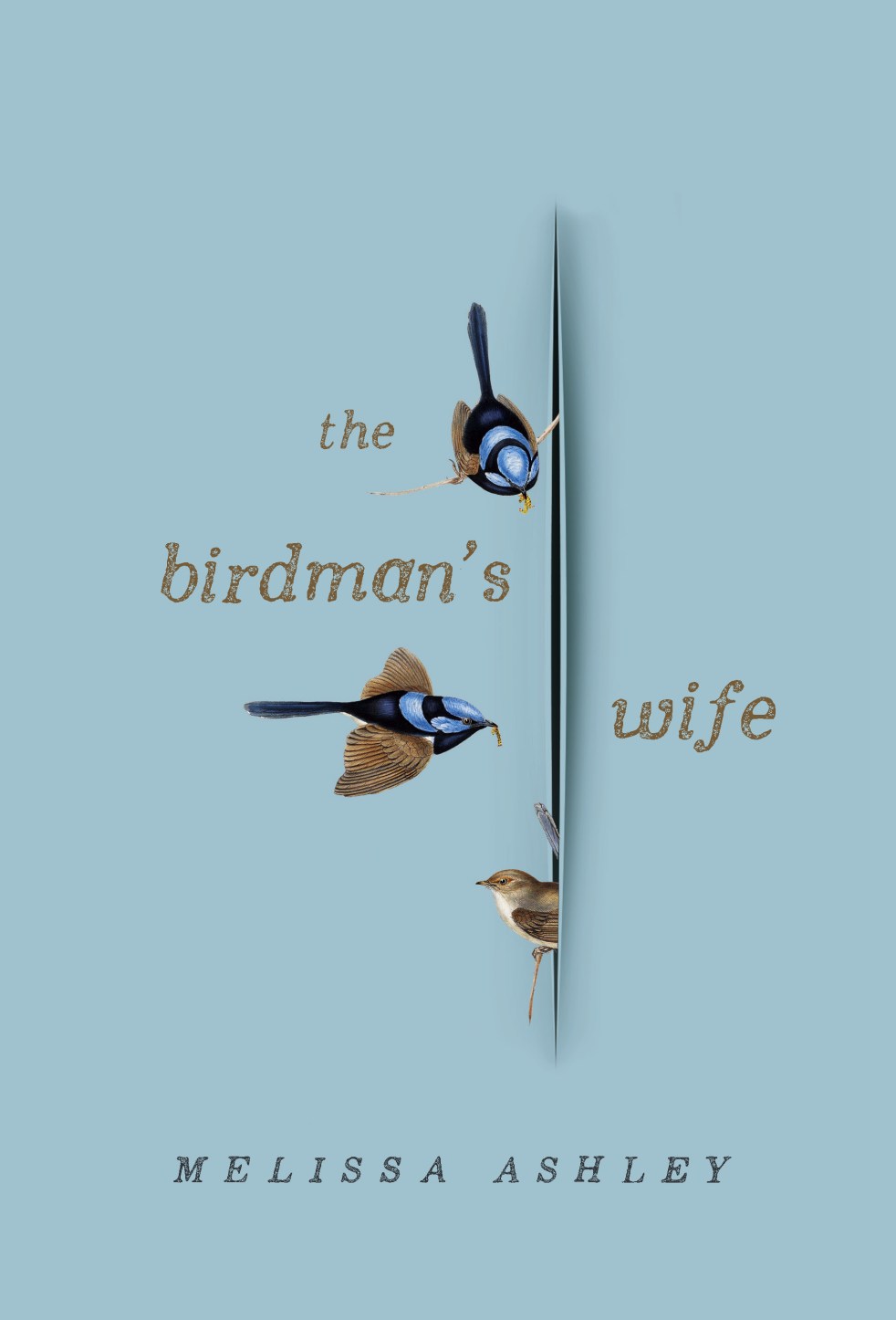
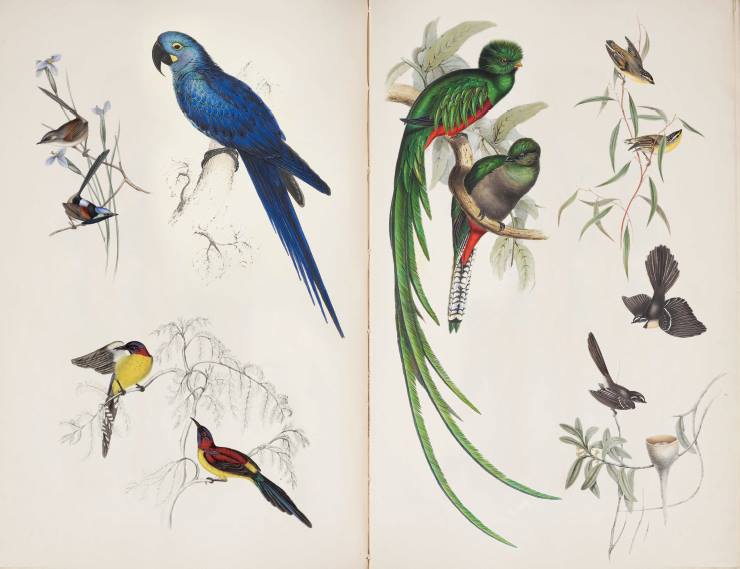
I can’t complete the review without reference to the production values of the book. I’m sure there’s many an Australian author and publisher in awe of this thing of wonder: a hard cover first novel. The beautiful Wedgwood or Robin’s Egg blue with its reproduction of Elizabeth Gould’s nested Fairy-Wrens feeding around a ‘tear’ invite or lure the reader further. Inside there are many illustrations featured in the book, including the pivotal Resplendent Quetzal.

This is an important work of redress allowing a woman of note to step out into the light again from where she had been hidden and neglected behind the plumage of her husband. Thank you Melissa Ashley for letting Elizabeth Gould ruffle some feathers again. I look forward to Melissa’s next book.

For more go to:

http://www.sarahridout.com.au/blog/2017/2/14/i6b3j0x8wst07xktdf68vafiaon8z1

Review

James Cowan reviews The Birdman’s Wife

Most of us have enjoyed ornithological art-works as objects of great beauty. They speak to us out of the rich world of birds, and imply their intricate lives as a part of the miracle of nature.

Melissa Ashley has sought to bring this world to life in her first novel, itself an object of great beauty. The life of Elizabeth Gould, the wife of John Gould, celebrated author of Birds of Australia, is explored in detail – she, as a fine illustrative artist in her own right.

We enter her world, one largely ignored by past historians who regarded her husband as the great luminary of his profession. What we do learn, however, is that Eliza was as much a part of the process as John Gould himself.  She was a team player, and a worthy one at that.

Eliza’s life in London, her early childbearing, her absolute devotion to her husband and his endeavors, are rendered in loving detail. We learn so much about the taxidermist’s craft as the author takes us on a journey into this little-known world of stuffing and illustrating birds, all in the name of natural science. Ashley paints it as a triumphant world, at least from the point of view of naturalists themselves, dedicated as they were upon establishing their scientific careers.

The difficulty of leaving her numerous children behind (except for one son, who accompanied them) in order to make the long and hazardous sea voyage to Tasmania is presented to us as a defining moment in the ornithological history of Australia, something that few of us would disagree with. That Australian bird life was brought to the attention of England and the world in the mid-1840s as a landmark event, the author never lets us forget.

Eliza’s story, which is a lonely one punctuated by her husband’s occasional return from expeditions into the hinterland to collect birds, or to Adelaide to join Captain Charles Sturt on one of his ill-fated journeys, reminds us that men of science in the nineteenth century were often obsessive individuals with little regard for their families. Children and wives were no more than social appendages, not people in their own right.

The character of Eliza Gould strikes us one of simple courage married to an utter devotion to her husband. He is handsome beyond words, so Eliza tells us, who seemingly always puts his work before his family, to which she rarely objects. It strikes an odd chord nearly two centuries later to think that men were often so predictably chauvinistic in their behavior.

Aside from drawing every dead bird that he laid before her, Eliza is also expected to give birth to eight children without recourse to abstinence or contraception. John does suggest a contraceptive device to her at one point in the book, but clearly it did not work!

The novel asks us to consider what we think about the craft of taxidermy, however, and how men like John Gould dismissed the death of so many birds in the name of science as being of less importance. Eliza also asks this question of herself on one occasion, but for some reason she fails to confront her husband about the issue. It might have lead to an interesting conversation about our willingness to use creaturely nature for our ends, had she done so.

The truth is that nineteenth-century scientists, with their mania for positing systems, genera, and categories (Darwin included) as a depiction of reality, has lead to cultural carelessness with regard to our fellow creatures sharing the same planet. Of course, this is seeing it through the lens of a later age, but it needs to be addressed as part of our understanding – or lack of – regard for sentient creatures themselves.

Ashley has written a book of careful and detailed research. It is amazing what she has uncovered in her bid to bring the world of ornithology and taxidermy to our attention. The streets of London are also beautifully described, so too daily events in the Tasmanian colony. It brings to mind the descriptions of Sydney Town that Patrick White did so very well in his novel Voss, itself an important observation of early colonial life in Australia.


The Birdman’s Wife is a well-written novel that reveals a great respect for the act of life-painting and taxidermy. Melissa Ashley has brought her own appreciation of birds to the page, and so vividly, in a cool and clearly rendered prose.  We are left in no doubt about their beauty, or their preciousness as a species.

Eliza Gould, too, strikes us as a woman of grave, if unreflective repute. To rectify our view of history, as Ashley has done through her story, nonetheless helps us to understand how such women have contributed more than their fair share to scientific inquiry over the centuries (witness: Eve Curie). This alone is an important observation, and we must be thankful to the author for alerting us to it.

The Birdman’s Wife by Melissa Ashley is a testament to the courage of such women against all odds.

James Cowan

Author of A Mapmaker’s Dream and Desert Father.

Review

Review of The birdman’s Wife by Elise McCune

The Birdman’s Wife by Australian author Melissa Ashley is a well written and researched book about artist Elizabeth Gould who was the wife of John Gould the famous Victorian ornithologist. I came a…

Source: The birdman’s wife by Melissa Ashley

Review

Reviews: The Birdman’s Wife

Australian Book Review: Anna McDonald Reviews The Birdman’s Wife by Anna

https://www.australianbookreview.com.au/abr-online/current-issue/190-january-february-2017-no-388/3777-anna-macdonald-reviews-the-birdman-s-wife-by-melissa-ashley

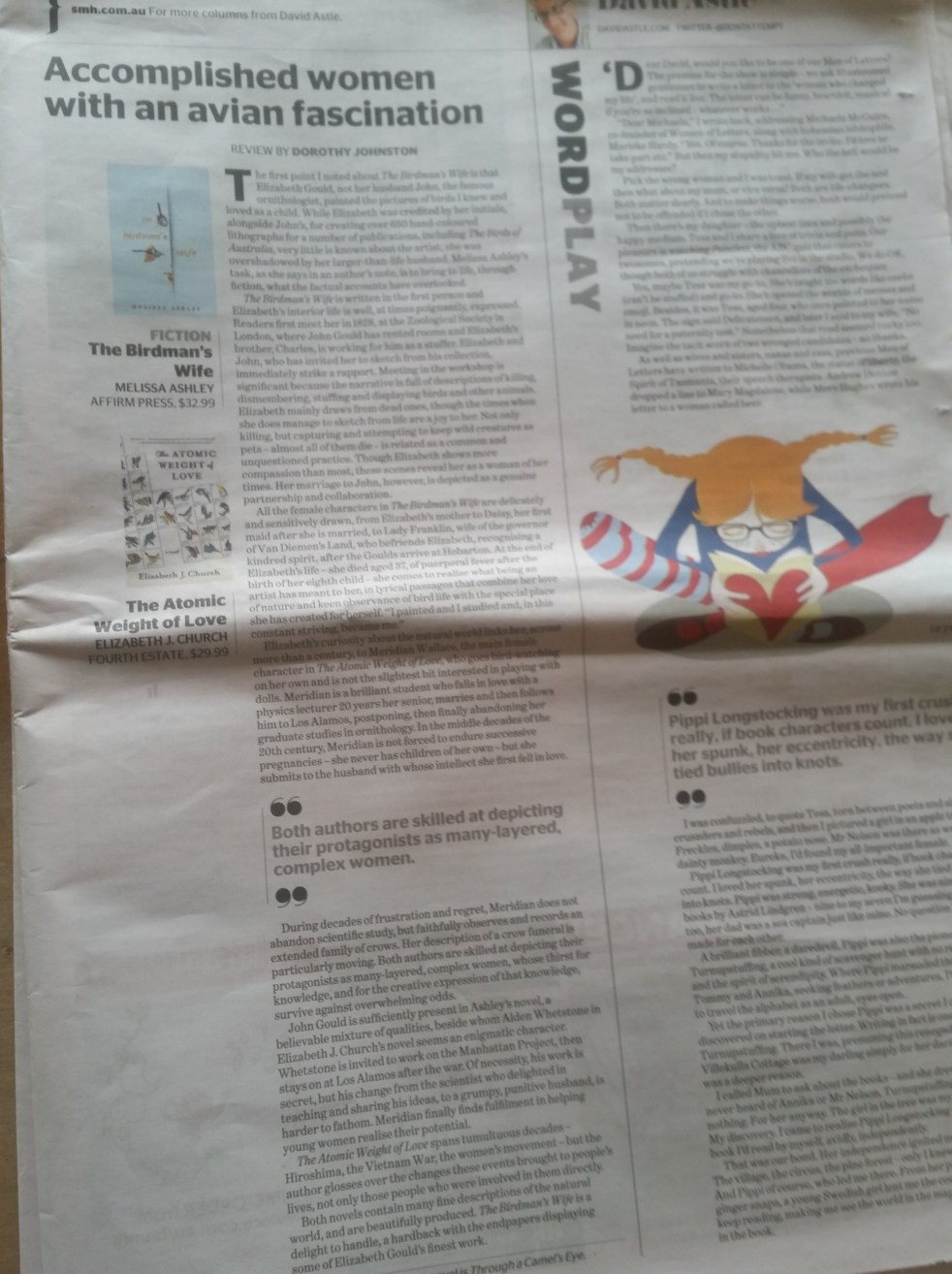
Sydney Morning Herald Reviews: The Birdman’s Wife by Melissa Ashley and The Atomic Weight of Love by Elizabeth J. Church by Dorothy Johnson

http://www.smh.com.au/entertainment/books/review-the-birdmans-wife-by-melissa-ashley-and-the-atomic-weight-of-love-by-elizabeth-j-church-20161103-gshg3x.html

Newtown Review of Books: Melissa Ashley: The Birdman’s Wife Reviewed by Tracy Sorensen

MELISSA ASHLEY The Birdman’s Wife. Reviewed by Tracy Sorensen

Art Almanac Reviews The Birdman’s Wife

http://www.art-almanac.com.au/category/book-reviews/

Arts Review: The Birdman’s Wife Review

The Birdman’s Wife

Compulsive Reader: A Review of The Birdman’s Wife by Melissa Ashley: Sue Bond

A review of The Birdman’s Wife by Melissa Ashley

Paper, Ink and Glue: Reivew of The Birdman’s Wife

Book Review: The Birdman’s Wife by Melissa Ashley (spoilers)

Lectito: Review of The Birdman’s Wife by Melissa Ashley (Margot)

Review: The Birdman’s Wife by Melissa Ashley

The Vince Review: The Birdman’s Wife by Paula Vince

http://vincereview.blogspot.com.au/2016/09/the-birdmans-wife-by-melissa-ashley.html

The Birdman’s Wife by Melissa Ashley: Isobel Blackthorn

The Birdman’s Wife by Melissa Ashley

The Senior: Book Review: The Birdman’s Wife

https://www.thesenior.com.au/entertainment/book-review-the-birdmans-wife/

Linked In: Nadia L King: The Birdman’s Wife

https://www.linkedin.com/pulse/book-review-birdmans-wife-melissa-ashley-nadia-l-king

Variety Bookroom

http://varietybr.com.au/2016/09/15/the-birdmans-wife-melissa-ashley/

Paula Stevson: Writer

The Birdman’s Wife

Readings Review by Annie Condon

https://www.readings.com.au/review/the-birdmans-wife-by-melissa-ashley

Historical Novel Society

The Birdman’s Wife

Kali Napier: Writer

The Birdman’s Wife – Book Review

Cass Moriarty: Writer (Facebook)

The Birdman’s Wife is the debut novel of Melissa Ashley, published by Affirm Press. It has arrived on the literary scene accompanied by a good deal of promotion and publicity – and for good reason. The Birdman’s Wife is a fascinating historical study, a meticulous and well-documented scientific report, an emotional story, and an engaging read.
Elizabeth Gould was a wife and mother, an artist andillustrator, a tenacious, curious, dedicated and adventurous woman. She was the Birdman’s Wife, the Birdman of course being John Gould, the famous father of ornithology, who spent much of the second half of the 1800’s collecting, displaying, cataloguing and publishing wildlife, most particularly native birdlife from the wilds of Australia. John Gould’s life and intellectual pursuits are well-documented; there are countless books by him and about him that depict his scientific endeavours. Less known is the invaluable contribution that his wife Elizabeth gave to his projects. In fact, while she was alive it seems it really was more a case of ‘their’ projects, for evidence points to Elizabeth playing a vital role in the studies they conducted.
In this novel, Melissa Ashley has pored over countless primary and secondary sources, she has travelled near and far, she has rolled up her sleeves and got her hands dirty experiencing taxonomy, she has hunted down descendants and family history, all in order to shine a spotlight on the talents and achievements of Elizabeth Gould. She has spun fiction from the base threads of fact, and what has resulted is a compelling and intriguing insight into Elizabeth’s mind, her actions, her emotions, her family life and her work.

Any book such as this automatically has a spoiler alert: any cursory internet search will reveal that Elizabeth Gould died after bearing her eighth child, at the young age of only 37. And yet this fact does not detract from the intense suspension and pace of the novel; it does not dissuade the reader from frantically turning the pages in order to discover what happens next. And so very much did happen in her relatively short life, and because the novel is written in such an engaging and interesting style we are immediately drawn to the voice of Elizabeth as it rises from the pages from over 150 years earlier; from the very first chapter we care deeply about this woman and her dreams, we fall in love with her, we fret with her about her children, we worry over the quality of her work, we feel her fear and trepidation as she embarks on the epic voyage that will change her life.

Elizabeth meets John Gould by chance. They marry, and discover they have much in common, including a love for animal and birdlife, and a desire to share their knowledge of creatures with others – John through his words and Elizabeth through her drawings. John skins and stuffs specimens; his wife illustrates them, capturing their essence, their colours, their peculiar poses or habits or characteristics. Her magnificent illustrations breathe life into her husband’s lifeless specimens. Together they produce definitive manuals on Australia’s birdlife after a two-year period of study here, the pair travelling (five months by sea) with their eldest son, and leaving their other children in the care of Elizabeth’s mother. She produced over 650 hand-coloured lithographs; she was asked to paint Charles Darwin’s Galapagos Finches. Nearly all of these works were signed by both her husband and herself, as was common at the time, but it was Elizabeth’s talent that really brought the beauty and uniqueness of many species to light.

Access to Elizabeth’s diary and correspondence have allowed Melissa to imagine the details and minutiae of her daily life. Her love for her children – the terrible wrench of leaving them in order to accompany her husband on his travels to the southern continent! Her feminist thoughts, bound by her Victorian constraints. Her artistic ambition, overshadowed always by her husband’s drive and reputation.

This book will appeal to artists, to environmentalists, to bird-lovers, to scientists and to taxonomists. But it also has general appeal to readers, to lovers of a good story. The writing is well-researched, concise and captivating. The story is gripping and enthralling – even though we already know the facts and the ending! Melissa achieves this by making it about the journey, not about the destination. Each new child, every fresh illustration, all of the small, quiet personal achievements, and each major scientific discovery – all are celebrated and enjoyed with equal pleasure.

And as an additional bonus, the beautifully-bound hardback is complete with full-colour endpapers of Elizabeth’s renderings.

I was fortunate to hear Melissa speak at theQueensland Museum & Sciencentre about her research and her forays into the (smelly) world of taxonomy, about her tantalising glimpse of Elizabeth the woman and how she set about discovering the whole of her life story in technicolour. It is clear that Melissa harbours a great love and respect for the bird world, and for those who had the opportunity years ago to make startling discoveries and world-first observations. It is also clear that she has managed to unveil the story behind one of the great and intrepid female characters of history. Surely the phrase ‘behind every great man stands an even greater woman’ must have been coined about Elizabeth Gould. I have seldom found history to be so absorbing and so thrilling, and yet so familiar and so relevant.
Review

Review: Sydney Morning Herald: Accomplished women with an avian fascination by Dorothy Johnson

http://www.smh.com.au/entertainment/books/review-the-birdmans-wife-by-melissa-ashley-and-the-atomic-weight-of-love-by-elizabeth-j-church-20161103-gshg3x.html


Review

Lectito Reviews The Birdman’s Wife by Melissa Ashley

Genre: Historical Fiction Many of us know something of English ornithologist, John Gould (1804–81), most famous for his collaboration with Charles Darwin and his pioneering study of Australian bird…

Source: Review: The Birdman’s Wife by Melissa Ashley

Review

The Birdman’s Wife ‘Book of the Week’ at Better Reading

http://www.betterreading.com.au/news/book-of-the-week-the-birdmans-wife-by-melissa-ashley/