Review

‘The Birdman’s Wife’ by Melissa Ashley: Review #AWW2017

by Sarah Ridout, author of Le Chateau
February 15, 2017This is my first review under my pledge to Australian Women Writers Challenge AWW2017

The Birdman’s Wife by Melissa Ashley
Affirm Press, 2016

‘The Birdman’s Wife’ is the timely resurrection to prominence of Elizabeth Gould, a fine artist and wife of John Gould, a noted Ornithologist in Regency England. The book tells Elizabeth’s story through courtship, marriage and motherhood, focusing on her work as an artist. As a work of ‘historical fiction,’ the time and multiple settings are so well researched and depicted that they come alive, including the figures of Edward Lear, Charles Darwin and Sir John and Lady Franklin. The Regency world in all its contradiction and change is seen in the lives and rise of the Goulds and their family.

Elizabeth Gould: a modern woman?

It was a clever strategy of Ashley’s to imagine her heroine, Elizabeth Gould, in a modern way, as a woman much like today’s professional mother who had to do it all. Elizabeth is a worker, mother, provider, lover – all pre-modern obstetrics, telephone, and even ocean liner. This depiction encourages readers to identify with Elizabeth, despite the large historical gap and her added assistance of servants, governess and cooks (and even mother and relation to look after assorted children while the Gould’ voyaged to Australia). This stance also allows Elizabeth to voice other ideas narratively, in keeping with modern views regarding the abundant specimens captured during her husband’s expeditions.

It allows Ashley to offer criticism of the practice through the character and also to have Elizabeth liberate some prized captives. To this reader there were parallels between the treatment of the native animals in Australia and that of the Aboriginals. That they were all treated as specimens to be used as the English saw fit, without any qualms of conscience. The unnecessary deaths of Australian animals, captured for the return voyage to England, was particularly hard to bare and written so deftly as to ride that fine balance between the ‘enlightened’ of the modern reader and outdated, immoral 19th century modes of behaviour. The character of Elizabeth at least, shows remorse for such savage waste.

Ashley has a great knowledge regarding birds and taxonomy and this depth and experience comes through on every page, especially the sections when dissections are occurring in the UK, on the voyages, and in Australia. The respect Ashley has for Elizabeth and her life and challenges is also evident and richly shown throughout.

993b9-1487123961613

Collecting: a construct of time, place and ideology

Fortuitously, I read the book while on holidays in Tasmania, where it was partly set. As an aside, while in Launceston, I saw ‘The Art of Science – Nicholas Baudin’s Voyagers 1800-1804’ an art exhibition of French explorers of Australia and their artworks from their voyages. I attended a lecture and was interested to learn that the French didn’t kill and return stuffed specimens for benefactors as the English (Gould et al) did, they drew and painted them only. Interestingly of course, they also only visited Australia, never ‘claiming’ it as their colony. The French expeditions predated the Gould’s.
One of the biggest insights for me from the novel was the act of collecting itself and what was entailed in the Gould expeditions. The detail Ashley provided of the sheer number of specimens killed shocked me. I think I’d always assumed they were all more like the French explorers, who drew from nature, rather than killing and preserving to take back trophies for museums or individual rich collectors.

Art and research creating layered characterisation

Scenes are cleverly written, offering layers of characterisation for multiple characters simultaneously. For example, the portrait painting scenes where the reader learns perhaps more about John Gould and his insecurities, cunning and political maneuvers, than they do of Elizabeth.

It’s hard to choose, but my favourite scenes were those depicting Elizabeth lost in her art, in the sheer ecstasy of creating and seeing something appear and fuse together on her blank page, born from her sheer talent and vision. The near possession Elizabeth experiences while creating the Resplendent Quetzal causes a very moving communion with her deceased children.

Reading the author’s note I was filled afresh with admiration at Ashley’s achievements in rendering Elizabeth Gould, having only eight pages of her diary remaining to act as a decoder for her thoughts and voice. Everything else was gleaned from years of research and study in Australia and America towards Ashley’s PhD. That layering of information and detail is rendered with dexterity.

Book Production Values: Congrats Affirm!

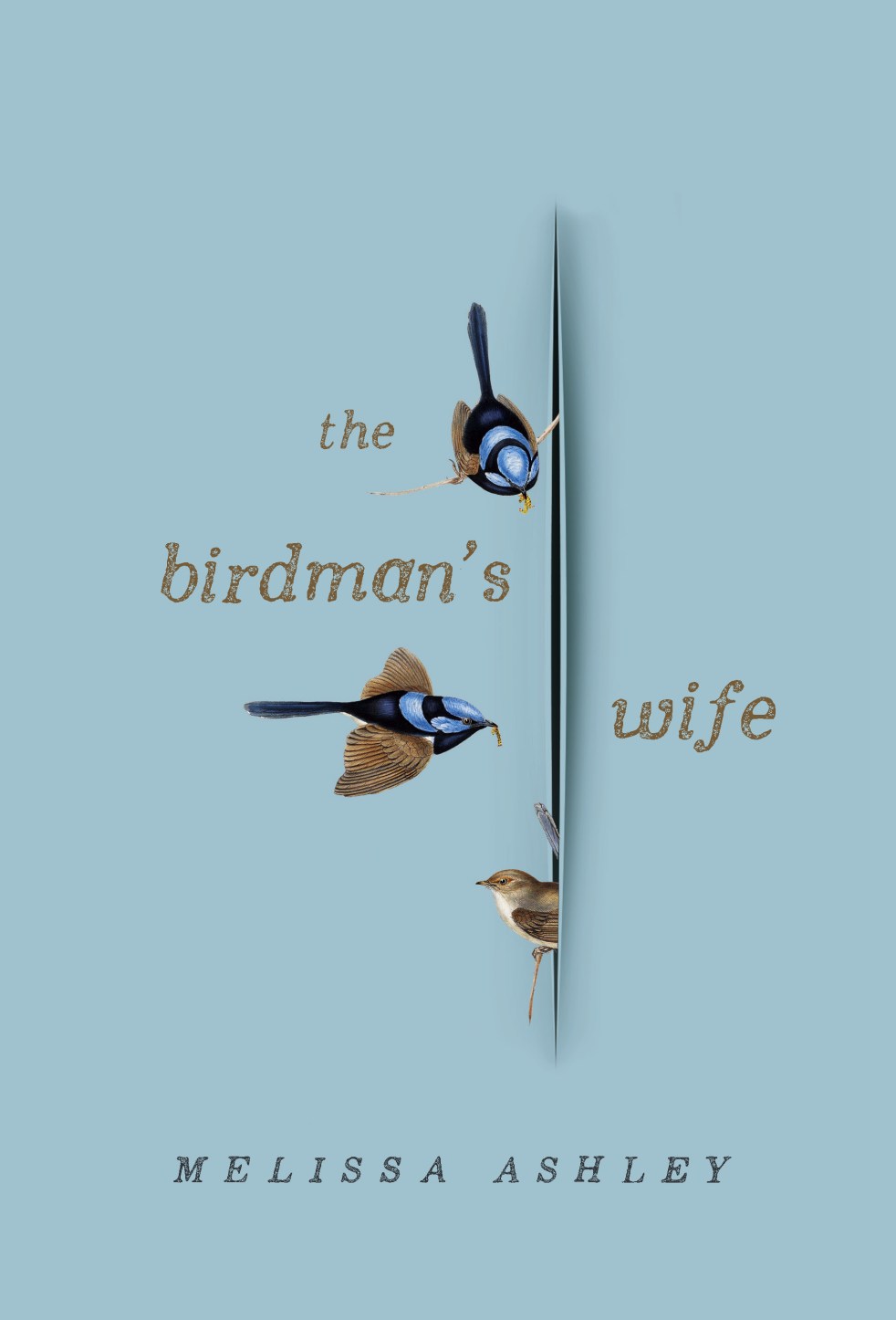
I can’t complete the review without reference to the production values of the book. I’m sure there’s many an Australian author and publisher in awe of this thing of wonder: a hard cover first novel. The beautiful Wedgwood or Robin’s Egg blue with its reproduction of Elizabeth Gould’s nested Fairy-Wrens feeding around a ‘tear’ invite or lure the reader further. Inside there are many illustrations featured in the book, including the pivotal Resplendent Quetzal.

This is an important work of redress allowing a woman of note to step out into the light again from where she had been hidden and neglected behind the plumage of her husband. Thank you Melissa Ashley for letting Elizabeth Gould ruffle some feathers again. I look forward to Melissa’s next book.

For more go to:

http://www.sarahridout.com.au/blog/2017/2/14/i6b3j0x8wst07xktdf68vafiaon8z1
Review

James Cowan reviews The Birdman’s Wife

Most of us have enjoyed ornithological art-works as objects of great beauty. They speak to us out of the rich world of birds, and imply their intricate lives as a part of the miracle of nature.

Melissa Ashley has sought to bring this world to life in her first novel, itself an object of great beauty. The life of Elizabeth Gould, the wife of John Gould, celebrated author of Birds of Australia, is explored in detail – she, as a fine illustrative artist in her own right.

We enter her world, one largely ignored by past historians who regarded her husband as the great luminary of his profession. What we do learn, however, is that Eliza was as much a part of the process as John Gould himself.  She was a team player, and a worthy one at that.

Eliza’s life in London, her early childbearing, her absolute devotion to her husband and his endeavors, are rendered in loving detail. We learn so much about the taxidermist’s craft as the author takes us on a journey into this little-known world of stuffing and illustrating birds, all in the name of natural science. Ashley paints it as a triumphant world, at least from the point of view of naturalists themselves, dedicated as they were upon establishing their scientific careers.

The difficulty of leaving her numerous children behind (except for one son, who accompanied them) in order to make the long and hazardous sea voyage to Tasmania is presented to us as a defining moment in the ornithological history of Australia, something that few of us would disagree with. That Australian bird life was brought to the attention of England and the world in the mid-1840s as a landmark event, the author never lets us forget.

Eliza’s story, which is a lonely one punctuated by her husband’s occasional return from expeditions into the hinterland to collect birds, or to Adelaide to join Captain Charles Sturt on one of his ill-fated journeys, reminds us that men of science in the nineteenth century were often obsessive individuals with little regard for their families. Children and wives were no more than social appendages, not people in their own right.

The character of Eliza Gould strikes us one of simple courage married to an utter devotion to her husband. He is handsome beyond words, so Eliza tells us, who seemingly always puts his work before his family, to which she rarely objects. It strikes an odd chord nearly two centuries later to think that men were often so predictably chauvinistic in their behavior.

Aside from drawing every dead bird that he laid before her, Eliza is also expected to give birth to eight children without recourse to abstinence or contraception. John does suggest a contraceptive device to her at one point in the book, but clearly it did not work!

The novel asks us to consider what we think about the craft of taxidermy, however, and how men like John Gould dismissed the death of so many birds in the name of science as being of less importance. Eliza also asks this question of herself on one occasion, but for some reason she fails to confront her husband about the issue. It might have lead to an interesting conversation about our willingness to use creaturely nature for our ends, had she done so.

The truth is that nineteenth-century scientists, with their mania for positing systems, genera, and categories (Darwin included) as a depiction of reality, has lead to cultural carelessness with regard to our fellow creatures sharing the same planet. Of course, this is seeing it through the lens of a later age, but it needs to be addressed as part of our understanding – or lack of – regard for sentient creatures themselves.

Ashley has written a book of careful and detailed research. It is amazing what she has uncovered in her bid to bring the world of ornithology and taxidermy to our attention. The streets of London are also beautifully described, so too daily events in the Tasmanian colony. It brings to mind the descriptions of Sydney Town that Patrick White did so very well in his novel Voss, itself an important observation of early colonial life in Australia.


The Birdman’s Wife is a well-written novel that reveals a great respect for the act of life-painting and taxidermy. Melissa Ashley has brought her own appreciation of birds to the page, and so vividly, in a cool and clearly rendered prose.  We are left in no doubt about their beauty, or their preciousness as a species.

Eliza Gould, too, strikes us as a woman of grave, if unreflective repute. To rectify our view of history, as Ashley has done through her story, nonetheless helps us to understand how such women have contributed more than their fair share to scientific inquiry over the centuries (witness: Eve Curie). This alone is an important observation, and we must be thankful to the author for alerting us to it.

The Birdman’s Wife by Melissa Ashley is a testament to the courage of such women against all odds.

James Cowan

Author of A Mapmaker’s Dream and Desert Father.

Review

Review of The birdman’s Wife by Elise McCune

The Birdman’s Wife by Australian author Melissa Ashley is a well written and researched book about artist Elizabeth Gould who was the wife of John Gould the famous Victorian ornithologist. I came a…

Source: The birdman’s wife by Melissa Ashley

Review

Small Acts of Disappearance

IMG_4590

Small Acts of Disappearance: Essays on Hunger by Fiona Wright

Giramondo Publishing, 2015

Anorexia Nervosa presents as a visual drama that exceeds the boundaries of language. It fascinates and repulses, hence the Current Affairs exposés and sensationalist memoirs—Marya Hornbacher’s manic Wasted and Portia DeRossi’s Unbearable Lightness: A Story of Loss and Gain, said to be something of an eating disorder manual. Google “anorexia recovery” and you’ll find thousands of links to tales describing the pain of walking away from this most deadly of diseases: anorexia nervosa has a mortality rate of 20%, higher than any other mental illness.

As there are a range of texts that catalogue the “spectacle” of anorexia, so, too, the subject attracts a variety of readers, from the gawping public, to the concerned friend, carer or partner, to the individual sufferer, desperate for comfort and a cure. Indeed, the anorexic devours books on their condition, a possible textual substitute for food, in their efforts to comprehend and outwit its tenacious hold. The force and persistence of anorexia eludes not only the slack-jawed public and the eating-disordered person’s frantic personal networks, but the sufferer herself.

In the collection, Small Acts of Disappearance, Fiona Wright uses the essay form to explore her decade-long experience of living with and confronting anorexia nervosa. The vehicle of the personal essay has been recently enriched by a slew of female writers’ discussions of embodiment and suffering—Rebecca Solnit, Leslie Jamison and Lidia Yuknavitch—to name just three. Wright’s essays on hunger are an addition to this fearlessly insightful group of women writers. In Leslie Jamison’s Empathy Exams—the narrator, not so much investigative journalist as metaphysician of suffering—strives to articulate the empathy she feels for her subjects, while self-castigating her non-debilitating unease. She frets that her project is voyeuristic, that she narcissistically exaggerates her own discomforts in an attempt to identify with the men and women whom she interviews, and the narratives that she weaves from their painful confessions.

This is not the case with Wright, who, in ten essays—set in hospital, Colombo, group therapy, Berlin, and in the land of reading—trains her fierce intellect on reflecting upon her eating disorder, divulging from the first paragraph her residency on the planet of the dangerously unwell. This may seem like a flippant observation, but, as a fellow inhabitant, I interrogated every one of Wright’s sentences for evidence that I might identify with her experiences. Did she possess the street cred of a serious mental illness? As her kin, the text’s psychological environment was an important gauge in determining the commitment of my reading, informing not only my intellectual engagement, but my emotional investment in Wright’s story.

Deciding that Wright’s voice passed the test of credible suffering, my next round of sceptical enquiry provoked the question, is she well? Has she recovered? Has she found a cure? The narrator’s position on the spectrum of health and sickness meant a lot to me. I needed to know if I could trust the intimacy of her writing, the unflinching honesty of her descriptions of sickness, the insights she served up with respect to her beguiling and confusing beliefs and behaviours. For, as Wright discovers, anorexia, and mental illness in general, is a slippery sort of being, endlessly inventive in its narratives and plots, its devices and strategies, to secure the sufferer’s unwavering attention. The network of suspicions, beliefs and fears that eating disorders create multiply inside the self like a virus. Its promises and rewards wriggle their way in, silently reproducing at the level of moment-to-moment thinking, such that one’s former self, by incremental changes in conviction, cognition and action, is gradually replaced by an alien not-self.

An example of anorexic-thinking is provided by Wright, in a statement she repeats several times in Small Acts’ opening essays. Admitting there is a problem in her relationship with food, in the weight she has lost, Wright seeks therapy, firm in the belief that she is isn’t a real anorexic: “I spent years determined to stay on the outside. Because I wasn’t, I was sure, one of those women” (20). In the essay “In Hospital,” in which Wight joins an outpatient programme for anorexics, she is placed in close contact with, “One woman (who) hadn’t had a bath in seven years…another would spend 800 dollars on groceries and seven hours vomiting each night…one would eat under-cooked chicken…in the hope she’d get salmonella” (22-23). In the narrator’s belief system, she is a special case, not really anorexic, her problems stemming from the involuntary vomiting eating causes her. She has myriad allergies, causing her to lose weight from narrowing her diet to a restricted range of foods. In the essay, “In Increments,” Wright reflects: “Sometimes I think that my physical illness, together with my personality, the length of time it took for the doctor to find a diagnosis while my body and brain adapted to malnutrition, were all together a perfect storm that broke, at some point in time that I’ll never quite pinpoint, and left this devastation in its wake” (74).

As a reader, my bulldust antennae flickered. That’s a lie! I shouted in judgemental silence.  You’re still sick. I trotted out my experiences of somatic illness. In the past year I’d suffered panic attacks, several of which were, to use the nineteenth-century terminology, undeniably ‘hysterical’. One presented as an epileptic fit, which sent me to hospital, after a ‘reaction’ to psychiatric medication I didn’t want to take. Another manifested as a somatic heart-attack, which came on after being given a piece of devastating news. The pain was felt in my body, my thoughts and emotions weirdly detached. I know intimately, the mystery of how one’s convictions—delusions?—can cause havoc in the limbs, digestive and endocrine systems. Wright’s refusal to recognise her eating disordered behaviour in the rituals and obsessions of the women in her outpatient programme reminded me of the protests of another anorexic, whose story I read online, a classics scholar at Cambridge who fervently believed she was not one of those women either. The scholar regarded eating disorder sufferers who were hospitalised with scorn and revulsion. As far as she was concerned, so long as she could sit exams (despite an increasing inability to eat), she’d not taken out a mortgage in the suburbs of the unwell.

In the same essay, “In Hospital,” the narrator further reflects, somewhat paradoxically, that she also “bore [the anorexic] women a strange kind of witness; a split kind of witness…where I didn’t want to be involved, didn’t think myself included, but couldn’t help but recognise myself reflected in the stories they told” (23). As a first step, Wright becomes a researcher in the discipline of eating disorders, collapsing the subject/object divide, surrendering her attachment to her anorexia to become a kind of double observer, recording and cataloguing the obsessions she’s developed around food and eating; her ritualistic behaviours before eating; the torturous feelings that arise following a meal. Like a diligent student, she reads up on the literature, uncovering studies on the effects of hunger on the body and analysing recovery statistics. She bravely admits her loneliness, isolation and confusion. Yet, several years after admitting she has an eating disorder, she has been repeatedly hospitalised. Despite therapy, programmes and the overturning of denial, despite months of hard work, most frustratingly she has not recovered. Intellectualising her behaviours and beliefs, thinking her way through her eating disorder by way of rationalisation, by measuring, recording and noting, appears to be an impoverished means of attack. “The horrible irony,” observes Wright, “is that eating disorders only happen to people who like definition and delineation, who like clarity and knowing where they stand, part of the process of moving past the illness is to learn that recovering can only be undefined, slow and without schedule, and riddled with mistakes and mess and temporary measures” (77).

A therapist advises her to get out of her head and “into [her] body” (144). She learns that her confusion and frustration are “important, generative,” and that she must stop “trying to understand, … stop narrating” (144). Strange advice for a writer who uses research and reason, analysis and synthesis, to arrive at clarity. About two-thirds into Small Acts, a noticeable shift in the narrator’s preoccupations becomes evident. Having taken her counsellor’s advice, Wright begins to explore her external environments, the worlds beyond her meticulously examined interiority. She writes of flatting and drinking, of enjoying lunches with her mother. In the essays “Books I” and “Books II,” she unravels the protagonists in Christina Stead’s The Man Who Loved Children and Carmel Bird’s Bluebird Café experiences of eating disorders, discussing the socio-cultural and familial networks that contribute to the characters’ unremitting sense of being a misfit in their communities, not to mention their very skins.

“The average time for recovery from an eating disorder is said to be seven years – the same length of time it takes for all of the cells in a human body to be replaced” (130). Without pinpointing, as Wright claims early in the book, the moment when her eating disorder began to take pathological hold, there is also no specific jolt of revelation, of epiphany, which picks her up and flies her towards wellness. Letting go of the stranglehold of anorexia is an incremental series of small acts, thoughts, and choices towards other people and activities, away from her alienated, isolated self. Wright realises that her belief that her illness was a case of her body letting her down—the unforced vomiting, the myriad allergies—might not be the whole story; her powerful intellect may also be implicated. As a reader, I finally breathed out, my vigilant search for lies and side-stepping come to a close. I began to marvel at Wright’s achievements, in both her text and her recovery. Small Acts inhabits the unstable territory of sickness with such verisimilitude, parts of the collection read as if she still lingers in these deserts. The narrator bears witness to the many stages in reconstructing the set of oneself, both within and without, the frame of serious mental illness. Wright’s remarkable narrative empathy, self-reflection and control, in turns lucid and cringingly vulnerable, gives hope to the afflicted sufferer and to the warily desperate friend, partner, carer and medico.

Small Acts navigates the island of mental illness, its most arresting topography the force with which it denies its victims self-acceptance, ease and a safe place in the world. But, as Wright notes, anorexia serves a purpose. The disease shores up vulnerability and uncertainty, it delivers a sense of agency and control. Hunger puts an individual on high alert, intensifying her sensory experiences and attenuating her consciousness—for reasons of survival, prolonged hunger is a crisis, which must be dealt with prior to every other need—and yet, paradoxically, the anorexic’s resistance to this biological demand rewards her with a sense of mastery and superiority, over her own (and others’) weakness and lack of will.

In concluding, Wright observes the fragility of her humanity: “I’m terribly afraid of living like this, sub-clinically, long-term. I know that I still have to fight hard for my own health, but also that sometimes I still don’t want to. I miss the simplicity of illness sometimes. Because the more acute pain is in trying to get better – and it’s a pain that’s chronic too – and in stripping away the protection, the insulation, the certainty that my hunger gave me” (173). Small Acts charts a metamorphosis in tiny increments, the damaged self undertaking the task of sloughing the disguise of mental illness, an unfathomably powerful rival to imperfect authenticity. Like Psyche’s ants’ job of winnowing enormous piles of grains to undo Venus’ bewitchment, the tentative steps taken in Small Acts produce a rare elegance and determined gait. Wright is a superb writer with an uncommon courage and will; her essays on hunger are an extraordinary gift.