Essay

Monday musings on Australian literature: ABDA 2017 Shortlist

Thank you whispering gums for this wonderful piece.

Whispering Gums's avatarWhispering Gums

Five years ago, I wrote a Monday Musings on book design, in which I featured three book designers. I’ve mentioned book design occasionally since then but, having just seen the shortlist for this year’s ABDA (Australian Book Design Awards) which are sponsored by the ABDA (the Australian Book Designers Association), I’ve decided to write another post on this aspect of the thing we love – books!

ABDA describes the awards as celebrating “the bravest and brightest, the most original and beautiful books published in Australia each year”. This year’s awards are the 65th! 65 years of celebrating book design! That’s wonderful, really. They make awards in sixteen categories, including four awards in Children’s and YA categories, and awards for specialist areas like Cookbooks, Fully-illustrated books, and Educational books.

I couldn’t possibly list all these, but if you are interested you can find them at the link I gave in the first…

View original post 766 more words

Essay

5 Lessons from Melissa Ashley to Boost Your Historical Research

Thanks so much for your wonderful interview and write-up!

amberseah2015's avatarAmber Seah

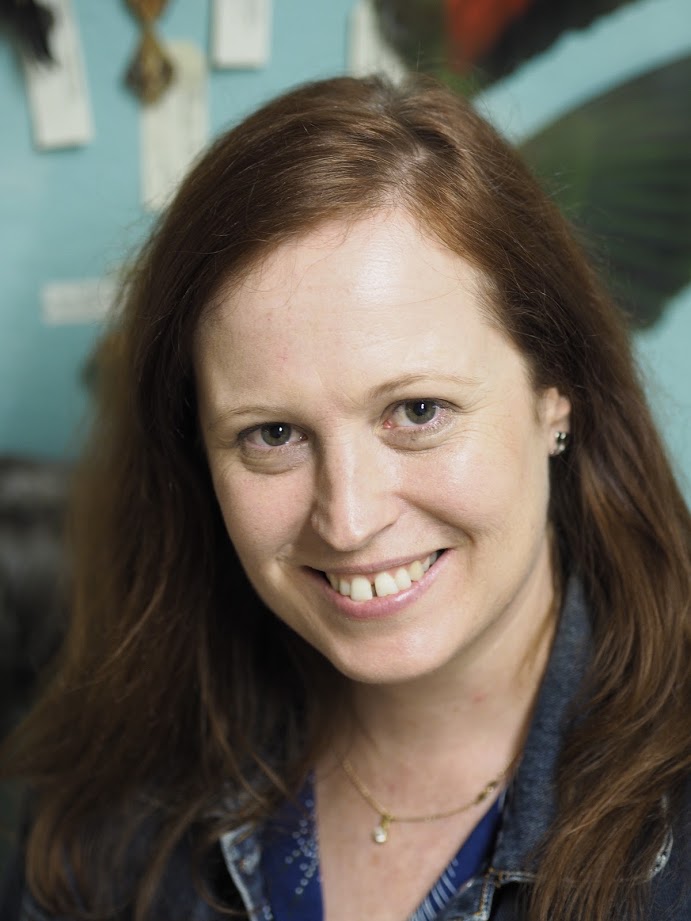
Promotional photo of Melissa Ashley Melissa Ashley Author of The Birdman’s Wife

A week ago I had the privilege to talk with Melissa Ashley over the phone and pepper her with questions about how she researched The Birdman’s Wife, about Elizabeth Gould and about her current work in progress based on the life of Marie-Catherine d’Aulnoy, a French writer of fairytales before the days of the Grimm brothers.

I only wish I had a podcast so you could hear the whole conversation, in lieu of that here are 5 valuable lessons I picked out to help you along the winding road of historical research.

To purchase The Birdman’s Wife  go here.

Meet Melissa Ashley

Melissa Ashley is the author of The Birdman’s Wife (Affirm Press, October 2016), the fictional memoir of the extraordinary 19th-century bird illustrator, Elizabeth Gould. The Birdman’s Wife is the child of her PhD in creative writing research (University of Queensland). In addition to…

View original post 1,386 more words

Essay

The Birdman’s Wife, shortlisted for the Australian Book Design Awards 2017

The Birdman27s Wife coverI’m excited that my debut novel The Birdman’s Wife has been shortlisted in the literary fiction category for the Australian Book Designer Association’s 2017 book awards.

I was privileged to work with Christa Moffitt of Christabella Designs, Fiona Henderson and Affirm Press on the cover, case, endpapers and page designs for The Birdman’s Wife.

I have always loved fairy wrens, the genus featured on the cover of The Birdman’s Wife. I lived in Ipswich for some years, and my partner planted a beautiful native garden, which attracted a family of superb fairy wrens. We used to drink our coffee on the veranda and listen to their soft twitterings.

redbacked fairywrenIt was on a twitch, early in my bird-watching career, that I first encountered red-backed fairy wrens, in the brambles along the banks of the Bremer River. A trip to Anstead Gardens revealed variegated fairy wrens, with their lovely chestnut wing coverts. During a stay at Bowra Conservation Reserve, we were lucky to encounter both white-winged fairy wrens, the males in their full summer colours of striking blue bodies, and white wings, along with splendid fairy wrens, still dressed in their winter plumage.

Driving to Broken Hill, we tweeted white-winged fairy wrens, this time in their black hybrid morphs. Travelling in Tasmania, I saw superb fairy wrens again, and imagined what Elizabeth Gould must have felt, viewing these friendly, inquisitive backyard wood birds for the first time, alive and active.

img_0725

Before coming to Australia, Elizabeth Gould had already illustrated several species of fairy wren, however, her drawings and coloured lithographs were taken from taxidermied specimens. Researching Elizabeth’s lithographs for The Birds of Australia, I was pleased to discover that Elizabeth drew 9 species of this lovely genus before her untimely death. They are some of her most exquisite lithographs for The Birds of Australia,

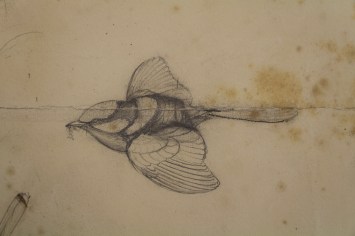
As part of my research to write The Birdman’s Wife, I travelled to Kansas, to the Spencer Research Library, where more than 2000 manuscripts, lithographs, drawings, sketches and paintings are stored, the preparatory work carried out by Elizabeth and John Gould and other artists to produce their magnificent plates. To my delight, I was privileged to view a signed pencil sketch of the superb fairy wren by Elizabeth Gould, which became the lithographed plate in The Birds of Australia.

IMG_2349

It was my secret hope that Elizabeth Gould’s iconic, hand-coloured lithograph of the superb fairy wren featured in the cover design for The Birdman’s Wife. You can imagine how chuffed I felt when my editor, publisher, and book-designer felt the same way.

Christa Moffitt came up with the original design for the cover, which, through the visionary generosity of Affirm Press, was combined with endpapers that feature many of Elizabeth Gould’s most well-known illustrations for The Birds of Australia: the superb lyrebird, the satin bowerbird, the extinct norfolk island kaka, along with several lithographs from earlier collections, including the resplendent quetzal and mrs gould’s sunbird, named after Elizabeth Gould.

13692655_10209613170342152_2518697375758487952_nAnd it didn’t stop there. I remember saying to my publisher at Affirm that my dream was to have a novel published. Little was I prepared for the sumptuous hardback that became the final novel. Not only does The Birdman’s Wife include full-colour endpapers – with a key to the featured species – there are other surprises inside the dust jacket: a full-colour reveal of Elizabeth Gould’s superb fairy wren on the case; an etching of the superb lyrebird from the frontispiece of the original release of The Birds of Australia – John Gould adored the lyrebird, crowning it the emblematic species of Australia’s unique birdlife. Flipping through the pages of The Birdman’s Wife more delights lie in store for the reader, including uncoloured lithographs of budgerigars, swifts, eggs, to punctuate the novel’s three distinct parts.

I’m so very pleased that the extraordinary vision of Affirm Press, Christabella Designs and my commissioning publisher Fiona Henderson has been recognised by the Australian Book Designer’s Association in its 2017 shortlist.

Essay

The Birdman’s Wife long-listed in the General Fiction Category, Australian Book Industry Awards 2017

The Birdman27s Wife coverI am delighted to announce the news that on March 16, 2017, The Birdman’s Wife was long-listed for the Australian Book Industry Awards under the General Fiction Category.

“For 17 years, the ABIAs have been celebrating Australian stories and the astounding talent in the Australian publishing industry.

The shortlist will be revealed on April 9, with the winners announced during the ABIA gala event on May 25, hosted by multiple ABIA-winning writer and performer, Magda Szubanski at the Art Gallery of NSW.”

http://abiawards.com.au/general/2017-abia-book-longlist/

General-fiction-boty
General Fiction Book of the Year

  • All These Perfect Strangers, Aoife Clifford (Simon & Schuster Australia)
  • The Birdman’s Wife, Melissa Ashley (Affirm Press)
  • The Chocolate Tin, Fiona McIntosh (Michael Joseph, Penguin Random House)
  • The Dry, Jane Harper (Macmillan Australia, Pan Macmillan Australia)
  • The Four Legendary Kingdoms, Matthew Reilly (Macmillan Australia, Pan Macmillan Australia)
  • The One Who Got Away, Caroline Overington (HarperCollins, HarperCollins Publishers)
  • The Rules of Backyard Cricket, Jock Serong (Text Publishing, Text Publishing)
  • Truly Madly Guilty, Liane Moriarty (Macmillan Australia, Pan Macmillan Australia

To view long-listed titles in other categories go to:

http://abiawards.com.au/general/2017-abia-book-longlist/

Interview

HNSA: Historical Novel Society Australia Interview

Melissa

Monday, March 13, 2017
Interview with Melissa Ashley

It’s a great pleasure to welcome to the blog Dr Melissa Ashley, a fiction writer, poet and academic who teaches creative writing workshops at the University of Queensland. Melissa is the author of the historical fiction, The Birdman’s Wife (Affirm Press, 2016), about the incredible life of the nineteenth-century illustrator, Elizabeth Gould, the wife of John Gould, the ‘father’ of Australian ornithology. Melissa has published papers and articles in Hecate, Text Journal of Creative Writing, Double Dialogues, The Age (Spectrum), The Lifted Brow and others. Her current project explores the life and writing of a seventeenth-century French author of fairy tales. You can connect with Melissa via her website, or through twitter,Facebook and Instagram.

From the interview, go to:

https://hnsaustralasia.blogspot.com.au/2017/03/interview-with-melissa-ashley.html

Interview

Indie Book Awards 2017 Author Q & A

Melissa Ashley – author of The Birdman’s Wife
Author Q&As

Tell us about your book, what inspired you to write it.

It all started when I fell in love with a poet, and with his poem about a bird.  We became avid birdwatchers together.  Writers, too.  When he rescued a ringneck parrot and we adopted it as a pet, a friend gave me a book about birds and a biography about John Gould, the famous ‘father’ of Australian ornithology.  That was how I discovered that his wife, Elizabeth, created the beautiful images of birds he wrote about in his exquisitely illustrated folios. She was portrayed as such a shadowy figure yet her work as an artist was so key to his fame and the history of birds that I became enthralled with her. I began researching Elizabeth’s life in earnest and the more I learned about her, the more determined I became to uncover her story.

I’ve always loved stories about women who are overlooked by history, and I find creative artistic relationships fascinating – Frida Kahlo and Diego Rivera; Mary Shelley and Percy Bysshe Shelley; Robert and Elizabeth Barrett Browning – so Elizabeth and John Gould’s intimate creative relationship added an extra spark of interest. Elizabeth Gould was such an intriguing enigma that I became convinced that she would be the ideal protagonist for an historical novel so I made her the subject of my PhD. Her story became a labour of love and my first novel.

For the remainder of the interview, go to:

https://www.indiebookawards.com.au/melissa-ashley-q-a?platform=hootsuite


Articles · Essay

Writers’ Festivals: Losing my Virginity

Last week I had the great privilege of being invited to perform as an artist at the 2017 Perth Writers’ Festival (23-26 February) to promote my first novel, The Birdman’s Wife, put into print by the incredible independent Australian publisher, Affirm Press.
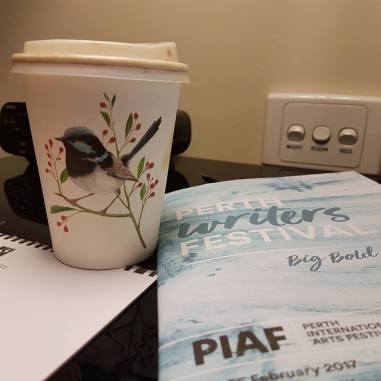
perthI have been very lucky in being invited to speak at a huge range of gigs: Newtown Festival; The Big Bookclub at the Avid Reader; Riverbend Books; QLD Museum; Mitchell Library; Farrells’ Bookstore in Hobart; Book Face; and a local environmental group. These events went really well (to my nervous relief). Terrified of public speaking, I was surprised to discover much enjoyment in signing books and meeting readers, discovering their various links to Elizabeth Gould’s story. Some were bird-watchers, some historians, others artists in their own right.

Having spent many years (too many to confess) as an eager punter at writers’ festivals, someone who would look in awe at the authors’ taking up each panel and speaking intelligently and eloquently about their books, I used to wonder at their nerves. I panicked, fearful of how they managed to follow each others’ conversations, how they weren’t intimidated by the huge crowds, how they didn’t have a nervous breakdown before and after each event.

gettingreadyTo prepare myself, I read all of the books of my fellow panelists, supplied by their publishers. I had no idea being a published writer entailed such perks. But, come the week I was flying to Perth, I felt myself consumed by a horrid stomach-full of nervous energy.

The first way that I spoke back to such intense emotion was to go shopping. New dresses, new earrings, hell, a new handbag even, to match my shoes. I couldn’t quite concentrate on my writing in the days precipitating my flight.

It was my first visit to Perth, and the festival organisers were brilliant, securing a lovely hotel room, shuttle buses, cash for food, and a bunch of other writers to get to know. Before my first gig, I met the beautiful Nadia L King, author of Jenna’s Truth, blogger, reviewer, instagram star and all-round supporter of writers. nadiafriends

berniceThe following day, I was so nervous about my impending first conversation, with the erudite Bernice Barry, author of a biography on Georgiana Molloy, a 19th century botanist from Western Australia, I wasn’t sure if I would make it to the outdoor space where I was to perform. And it was really hot, the 36+ degree temperature (not unlike the whole of Brisbane’s heatwave summer) following me all the way to Perth.

To my great relief and gratitude, Martin Hughes, CEO of Affirm Press, flew in to accompany me, to talk me up and talk down my nerves before I stepped in front of the microphone and crowds. My first gig was a full house and it went well, despite my discomfort at being out of a familiar place, and several paramedics turning up 55 minutes into our conversation to cart off several members of the audience who had succumbed to the heat. We stopped immediately, though I felt concerned about the temperature forecast for the following day: over 40 degrees.

fullhouse

As if in some sort of compensation, an audience member had sketched Bernice, Barbara Horan, our lovely chair, and myself, while we spoke. Afterwards, the artist  came up to the stage and introduced herself, asked us all to autograph her sketch. What a gift.
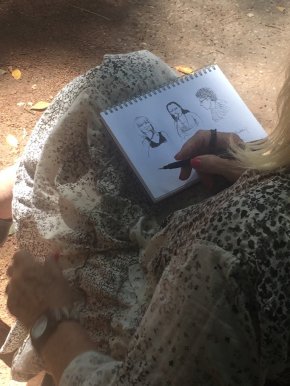
sketchI signed a few books, and then scurried away for a cigarette, my rapidly beating heart slowed, at least for the moment. I had a great dinner with Martin, laughs and drinks, all precipitated by a confused wander through the streets of Perth’s CBD (neither of us has much of a sense of direction).

Nevertheless, I couldn’t sleep much that night. I worried incessantly about my two gigs the following day. One of which was with my literary heroine, Hannah Kent. Would I turn to jelly in her presence? And then I moved on and fixated on the belief that I was not comfortable talking about The Birdman’s Wife without notes for the proscribed ten minutes the panel required. Once our chair, the lovely Geraldine Blake, and Martin reassured me that I could present in the manner which made me most comfortable, my nerves gripped onto another unknown. Due to the fame of Hannah, I panicked that we were about to perform in an indoor Roman arena. Would I get ‘the chokes’ like Howard Moon from The Mighty Boosh and humiliate myself entirely? Or fall over a mike lead or spill my water and electrocute Hannah or some other unanticipated embarrassment? Exposed as a buffoon, the butt of everyone’s jokes.

Somehow — it really is a blur –I got a hold of my nerves and turned up the following morning to meet Hannah Kent, author of Burial Rites and The Good People. To gush over Jessie Burton, writer of the bestselling novels The Miniaturist and The Muse. I sweated in a most unladylike fashion in their company, pressing my legs together (the toilet line was looong), trying to not fan-girl them too badly. Though I could not help raving about their mastery of structure, plot, dialogue, character, lyricism. When I stilled my jabbering jaws, I marvelled as they engaged in pre-gig laughs about jetlag from visiting Iceland, New York. I nodded and grinned, trying to not appear insane, shaking hands pinned behind my back.

Jessie-a trained actor-and Hannah, a consummate writer – spoke with intelligence, respect, humour and openness. I was proud that I managed to not stumble my own answers to Geraldine’s questions. I felt the warmth in the room that lit up their fans, turned out to see their favourite writers in the flesh. Afterwards, we traipsed over to the book-signing room; Martin reckoned I smashed it, and I felt pretty chuffed that I managed to save face. That was until the extraordinary Clementine Ford (deep bows) arrived and I noted that I was seated between her beautifully fierce self and my literary crush, Hannah Kent. Luckily my hand-bag carrier/publisher was lurking, and bade me make a hasty exit.

hannahandjessieBoth evenings I had dinner with my publisher. I think I told him about five times that I signed with Affirm Press because of their manifesto of building a relationship with their writers. They have integrity, guts, and are willing to take a risk with somebody whose writing they believe in. That evening, apart from trawling half of Perth’s CBD in search of a restaurant, I learned much about publishing, book sales, prizes, and literary passion. I returned to my hotel feeling looked after and reassured. Affirm Press believed in me.

Nevertheless, it wasn’t long before my anxiety reared up and grasped me by the throat. To calm my nerves, Martin distracted me by asking about the poem I loved best in all the world. It was in fact resonating through my brain all weekend, written by the maddest of mad poets, Robert Lowell. I dare not share Waking in the Blue (my real favourite) and instead confessed a penchant for the mysterious Skunk Hour:

Skunk Hour

For Elizabeth Bishop


Nautilus Island’s hermit
heiress still lives through winter in her Spartan cottage;
her sheep still graze above the sea.
Her son’s a bishop.  Her farmer
is first selectman in our village,
she’s in her dotage.

Thirsting for
the hierarchic privacy
of Queen Victoria’s century,
she buys up all
the eyesores facing her shore,
and lets them fall.

The season’s ill--
we’ve lost our summer millionaire,
who seemed to leap from an L. L. Bean
catalogue.  His nine-knot yawl
was auctioned off to lobstermen.
A red fox stain covers Blue Hill.

And now our fairy 
decorator brightens his shop for fall,
his fishnet’s filled with orange cork,
orange, his cobbler’s bench and awl,
there is no money in his work,
he’d rather marry.

One dark night,
my Tudor Ford climbed the hill’s skull,
I watched for love-cars.  Lights turned down, 
they lay together, hull to hull,
where the graveyard shelves on the town. . . .
My mind’s not right.

A car radio bleats,
‘Love, O careless Love . . . .' I hear
my ill-spirit sob in each blood cell,
as if my hand were at its throat . . . .
I myself am hell;
nobody’s here--

only skunks, that search
in the moonlight for a bite to eat.
They march on their soles up Main Street:
white stripes, moonstruck eyes’ red fire
under the chalk-dry and spar spire
of the Trinitarian Church.

I stand on top
of our back steps and breathe the rich air--
a mother skunk with her column of kittens swills the garbage pail
She jabs her wedge-head in a cup
of sour cream, drops her ostrich tail,
and will not scare.

All weekend, I wanted desperately to connect with my fellow writers but I was so overwhelmed by my professional responsibilities that it was simply not possible. I would have gushed, stuttered and knocked something over — I had already done all of this in front of my work colleague and friend Elspeth Muir, with whom I caught the plane — and decided I would be better off saving myself for the next festival.

By the time I got to my final gig, a conversation with Kate Summerscale, author of The Wicked Boy, a biography of a 13 year old boy who stabbed his mother to death, spent 17 years in a mental asylum and then emigrated to Australia to become a decorated ANZAC medic, my brain had nearly imploded. Despite Susan Wyndham’s excellent facilitation as chair, a week of intense anxiety resulted in a challenging panel. I felt my responses to anticipated questions running away from my consciousness before I had even started speaking. Yes, I rambled somewhat.
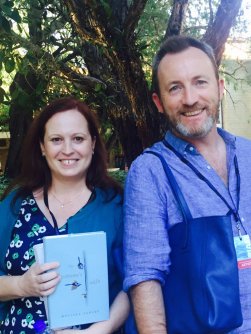
perthfestivalmartinI burst into embarrassing tears following my last panel, and yet, despite my red eyes and blubbering, I felt as if I had pushed myself to the very limits of my abilities with regard to public speaking. I was sorta proud, despite my feelings of utter humiliation. I think many writers feel this. It’s just how we are.

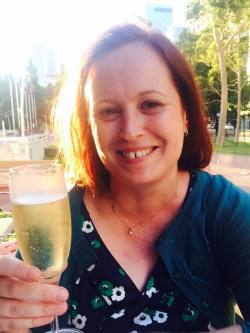
That evening I had a few too many (deserved) champagnes, which led to a remarkable opportunity. I hung out with Deng Adut, a former child soldier from South Sudan who runs a human rights legal practice and has been honoured as a New South Welshman of the year, one of the real superstars of the festival.

All in all, my first writers’ festival was an incredible experience. I’m still thinking about it three days later. At the airport, I ran into Elspeth Muir, author of Wasted, a memoir about alcohol consumption in Australia and a family tragedy, recently long-listed for the Stella Prize, who I work with at the University of Queensland. It seems my intense nerves are not unique. We commiserated about speaking alongside literary superstars, about our guts and relief, laughing, spilling coffee, giggling and riffing off one another, so much so that we almost missed our flight home.perthbubblies
I have several more festivals this year, and am so relieved I survived my first. An initiation in no small sense of the term. Six months ago, after ten years’ effort, I published my first novel. It was a labour of love, and I thought that once I had got on the other side of the publisher’s door, all would be well. Little did I know that a whole other world of sales and publicists and editors and talks lay in wait. But I did it. I’m not sure if I will ever be totally comfortable with public speaking. But I’m still here, I signed a few books and my heart’s still beating. Next time, I’ve decided, I’m going to meet some writers!!

Review

‘The Birdman’s Wife’ by Melissa Ashley: Review #AWW2017

by Sarah Ridout, author of Le Chateau
February 15, 2017This is my first review under my pledge to Australian Women Writers Challenge AWW2017

The Birdman’s Wife by Melissa Ashley
Affirm Press, 2016

‘The Birdman’s Wife’ is the timely resurrection to prominence of Elizabeth Gould, a fine artist and wife of John Gould, a noted Ornithologist in Regency England. The book tells Elizabeth’s story through courtship, marriage and motherhood, focusing on her work as an artist. As a work of ‘historical fiction,’ the time and multiple settings are so well researched and depicted that they come alive, including the figures of Edward Lear, Charles Darwin and Sir John and Lady Franklin. The Regency world in all its contradiction and change is seen in the lives and rise of the Goulds and their family.

Elizabeth Gould: a modern woman?

It was a clever strategy of Ashley’s to imagine her heroine, Elizabeth Gould, in a modern way, as a woman much like today’s professional mother who had to do it all. Elizabeth is a worker, mother, provider, lover – all pre-modern obstetrics, telephone, and even ocean liner. This depiction encourages readers to identify with Elizabeth, despite the large historical gap and her added assistance of servants, governess and cooks (and even mother and relation to look after assorted children while the Gould’ voyaged to Australia). This stance also allows Elizabeth to voice other ideas narratively, in keeping with modern views regarding the abundant specimens captured during her husband’s expeditions.

It allows Ashley to offer criticism of the practice through the character and also to have Elizabeth liberate some prized captives. To this reader there were parallels between the treatment of the native animals in Australia and that of the Aboriginals. That they were all treated as specimens to be used as the English saw fit, without any qualms of conscience. The unnecessary deaths of Australian animals, captured for the return voyage to England, was particularly hard to bare and written so deftly as to ride that fine balance between the ‘enlightened’ of the modern reader and outdated, immoral 19th century modes of behaviour. The character of Elizabeth at least, shows remorse for such savage waste.

Ashley has a great knowledge regarding birds and taxonomy and this depth and experience comes through on every page, especially the sections when dissections are occurring in the UK, on the voyages, and in Australia. The respect Ashley has for Elizabeth and her life and challenges is also evident and richly shown throughout.

993b9-1487123961613

Collecting: a construct of time, place and ideology

Fortuitously, I read the book while on holidays in Tasmania, where it was partly set. As an aside, while in Launceston, I saw ‘The Art of Science – Nicholas Baudin’s Voyagers 1800-1804’ an art exhibition of French explorers of Australia and their artworks from their voyages. I attended a lecture and was interested to learn that the French didn’t kill and return stuffed specimens for benefactors as the English (Gould et al) did, they drew and painted them only. Interestingly of course, they also only visited Australia, never ‘claiming’ it as their colony. The French expeditions predated the Gould’s.
One of the biggest insights for me from the novel was the act of collecting itself and what was entailed in the Gould expeditions. The detail Ashley provided of the sheer number of specimens killed shocked me. I think I’d always assumed they were all more like the French explorers, who drew from nature, rather than killing and preserving to take back trophies for museums or individual rich collectors.

Art and research creating layered characterisation

Scenes are cleverly written, offering layers of characterisation for multiple characters simultaneously. For example, the portrait painting scenes where the reader learns perhaps more about John Gould and his insecurities, cunning and political maneuvers, than they do of Elizabeth.

It’s hard to choose, but my favourite scenes were those depicting Elizabeth lost in her art, in the sheer ecstasy of creating and seeing something appear and fuse together on her blank page, born from her sheer talent and vision. The near possession Elizabeth experiences while creating the Resplendent Quetzal causes a very moving communion with her deceased children.

Reading the author’s note I was filled afresh with admiration at Ashley’s achievements in rendering Elizabeth Gould, having only eight pages of her diary remaining to act as a decoder for her thoughts and voice. Everything else was gleaned from years of research and study in Australia and America towards Ashley’s PhD. That layering of information and detail is rendered with dexterity.

Book Production Values: Congrats Affirm!

I can’t complete the review without reference to the production values of the book. I’m sure there’s many an Australian author and publisher in awe of this thing of wonder: a hard cover first novel. The beautiful Wedgwood or Robin’s Egg blue with its reproduction of Elizabeth Gould’s nested Fairy-Wrens feeding around a ‘tear’ invite or lure the reader further. Inside there are many illustrations featured in the book, including the pivotal Resplendent Quetzal.

This is an important work of redress allowing a woman of note to step out into the light again from where she had been hidden and neglected behind the plumage of her husband. Thank you Melissa Ashley for letting Elizabeth Gould ruffle some feathers again. I look forward to Melissa’s next book.

For more go to:

http://www.sarahridout.com.au/blog/2017/2/14/i6b3j0x8wst07xktdf68vafiaon8z1

Articles · Booklists

The Birdman’s Wife: Shortlisted for Indie Book Awards

Congratulations to Jane Harper, author of The Dry, winner of the Debut Fiction category, and the Indie Book Awards Book of the Year. Well-deserved!
SHORTLIST ANNOUNCED FOR THE 2017 INDIE BOOK AWARDS

January 16, 2017


Australian independent booksellers are pleased to announce the Shortlist for The Indie Book Awards 2017.


The Indie Book Awards, as chosen by independent booksellers, members of Leading Edge Books, reward and promote excellence in Australian writing.  Galina Marinov, National Group Manager of Leading Edge Books says, ‘There are no bigger supporters of Australian writing and publishing in this country than independent booksellers. Their love of book, knowledge and passion for Australian stories play indispensable role in keeping Australian publishing and culture alive. The 2017 Indie Book Awards Shortlist is a tribute to the enormous depth and breadth of writing talent in this country. We are excited to be supporting and working on the Indie Book Awards campaign again and look forward to the announcement of the Category Winners and the overall Indie Book Awards Winner on 20th March.’


Affectionately termed ‘indies’, Australian independent booksellers have a proud reputation for choosing the best in Australian writing, with many of the shortlisted books in previous years going on to be bestsellers and win other major literary awards. Since its inception in 2008, the Indie Book Awards have chosen Breath by Tim Winton, The Happiest Refugee by Anh Do, Jasper Jones by Craig Silvey, All That I Am by Anna Funder, The Light Between Oceans by M.L. Stedman, The Narrow Road to the Deep North by Richard Flanagan, The Bush by Don Watson and The Natural Way of Things by Charlotte Wood as previous overall winners.


The twenty shortlisted books will be vying for the top spot as the Indie ‘Book of the Year’ for 2017. Panels of expert judges (all indie booksellers and avid readers) will choose the winners in the five book categories – Fiction, Debut Fiction, Non-Fiction, Children’s and Young Adult. Independent booksellers from around the country will then vote to select their favourite book for the year.

The category winners and the overall ‘Book of the Year’ winner will be announced on Monday, 20th March, 2017 at the Leading Edge Books Annual Conference Awards Dinner, at the Marriott, Surfers Paradise.

The Shortlist for The Indie Book Awards 2017 is:

FICTION SHORTLIST
The Good People by Hannah Kent (Pan Macmillan Australia)

Truly Madly Guilty by Liane Moriarty (Pan Macmillan Australia)

Where the Trees Were by Inga Simpson (Hachette Australia)

The Last Painting of Sara de Vos by Dominic Smith (Allen & Unwin)

NON-FICTION SHORTLIST

The Hate Race by Maxine Beneba Clarke (Hachette Australia)

Ghost Empire by Richard Fidler (ABC Books, HarperCollins Australia)

Fight Like a Girl by Clementine Ford (Allen & Unwin)

Everywhere I Look by Helen Garner (Text Publishing)
DEBUT FICTION SHORTLIST
The Birdman’s Wife by Melissa Ashley (Affirm Press)

The Midnight Watch by David Dyer (Penguin Books Australia)

The Dry by Jane Harper (Pan Macmillan Australia)

Goodwood by Holly Throsby (Allen & Unwin)

CHILDREN’S SHORTLIST

Circle by Jeannie Baker (Walker Books Australia)

Pig the Winner by Aaron Blabey (Scholastic Australia)

The 78-Storey Treehouse by Andy Griffiths & Terry Denton (Illus) (Pan Macmillan Australia)

Wormwood Mire by Judith Rossell (ABC Books, HarperCollins Australia)

YOUNG ADULT SHORTLIST

Words in Deep Blue by Cath Crowley (Pan Macmillan Australia)

Gemina by Amie Kaufman and Jay Kristoff (Allen & Unwin)

The Road to Winter by Mark Smith (Text Publishing)

Our Chemical Hearts by Krystal Sutherland (Penguin Books Australia)

The Indie Book Awards would like to gratefully acknowledge the 2017 Awards Sponsors: HarperCollins Australia, Pan Macmillan Australia, Hardie Grant, Hachette Australia, Bonnier Publishing and Hardie Grant Egmont, and Awards supporter: Simon & Schuster Australia.

For an article about the indie awards click on the link below:
http://www.smh.com.au/entertainment/books/indie-book-awards-2017-shortlists-maxine-beneba-clarkes-hard-sell-20170113-gtr8iz.html
Articles

UQ graduate brings trailblazing woman out of shadows

A “naïve young girl…who defied convention by embarking on a trailblazing expedition” documenting Australia’s wildlife is the subject of a book by a University of Queensland graduate.

In her debut work of fiction The Birdman’s Wife, UQ School of Communications and Arts alumna Melissa Ashley has reimagined the life of artist and illustrator Elizabeth Gould.

“It’s a creative interpretation of her life capturing Australia’s unique birdlife,” Ms Ashley said.

“Elizabeth was very much a woman overshadowed in history by her husband John Gould, often credited with being the father of Australian ornithology.

“She juggled demands as a wife, lover and mother to an ever-growing brood of children with her prolific career relaying the sublime beauty of birds the world had never seen before.

“Her legacy was well eclipsed by the fame of her husband, despite her breathing life into hundreds of exotic new species through lithographs, including Charles Darwin’s Galapagos finches.”

The Birdman’s Wife began as a PhD project for Ms Ashley, but the “labour of love” eventuated into a nomination for the Indie Booksellers’ 2017 Book Awards.

In the author’s note she gave credits to UQ supervisors Associate Professor Bronwyn Lea and Dr Melissa Harper, the School of Communication and Arts, and acknowledged funding from the UQ Graduate School.

So inspired was Ms Ashley by bringing the life of Elizabeth Gould to print, she even volunteered as a taxidermist at Queensland Museum.

“Elizabeth was a woman ahead of her time,” Ms Ashley said.

“She was – and deserves to be remembered as – so much more than the lady behind the man.”

Born in Ramsgate, England as Elizabeth Coxen in 1804, she died at age 37 not long after the birth of her eighth child.

Elizabeth spent some of her final years in Australia, based in Hobart, before returning to England.

Her brother Charles Coxen also immigrated to Australia and was a member of the Queensland Philosophical Society.

Both the Gouldian finch and Mrs Gould’s sunbird were named in Elizabeth’s honour.

Author Ms Ashley will appear at Riverbend Books on Thursday, 16 February at 6.30pm to discuss The Birdman’s Wife.

Other events on her radar include the Perth International Arts and Writers’ Festival on 24-25 February and the World Science Festival at Queensland Museum on 25 March.

The Birdman’s Wife is published by Affirm Press.


https://www.uq.edu.au/news/node/120210