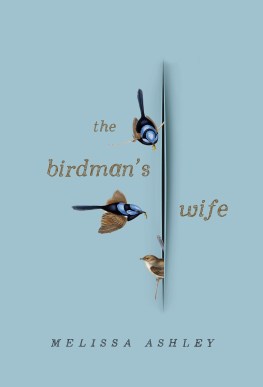
Melissa Ashley is the author of the best-selling, award-winning historical fiction novels The Birdman's Wife and The Bee and the Orange Tree. Her latest novel, The Naturalist of Amsterdam, is released on October 10, 2023 (Affirm Press).
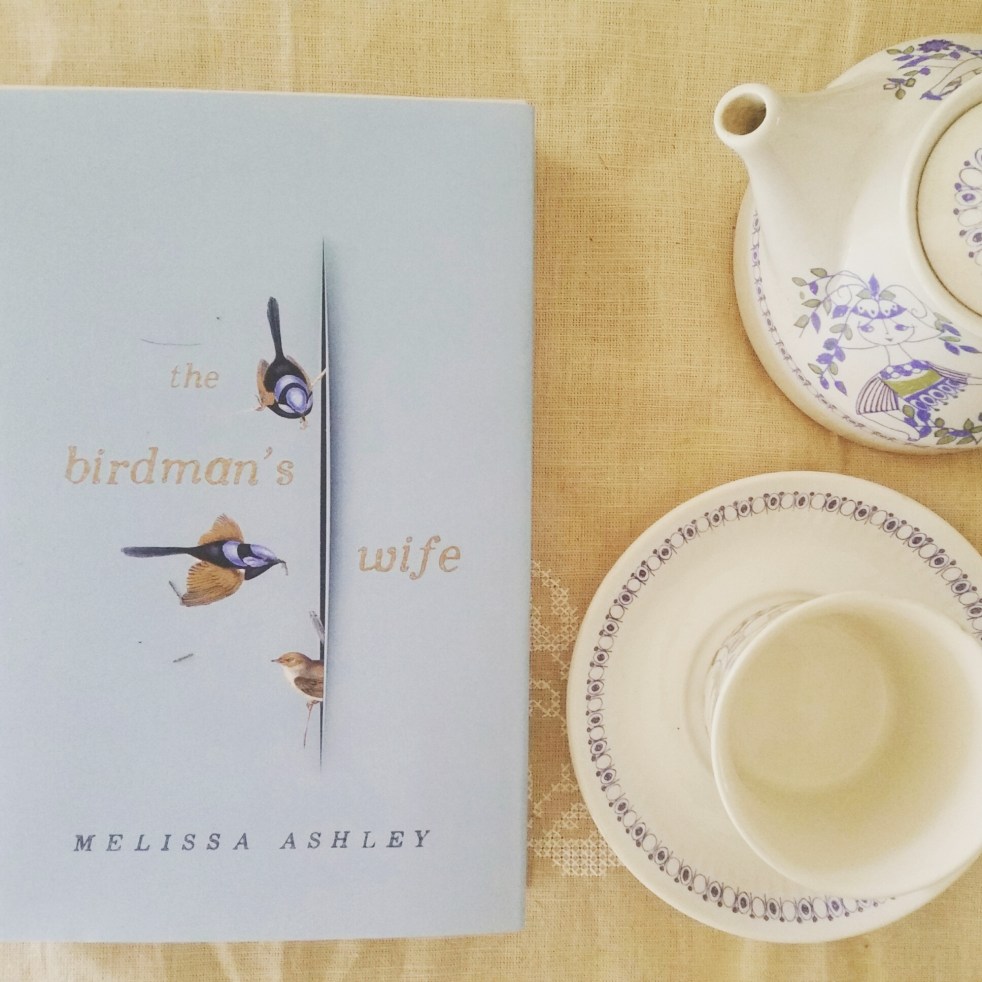
I’m thrilled, excited and a little stunned that The Birdman’s Wife has made the list of the Best Books of October on Apple’s ibooks feature. The Birdman’s Wife is available as an ebook and can be read on any device. Go ibooks! And thank you.
Press on the link to go straight to the ibooks link Birdman’s Wife
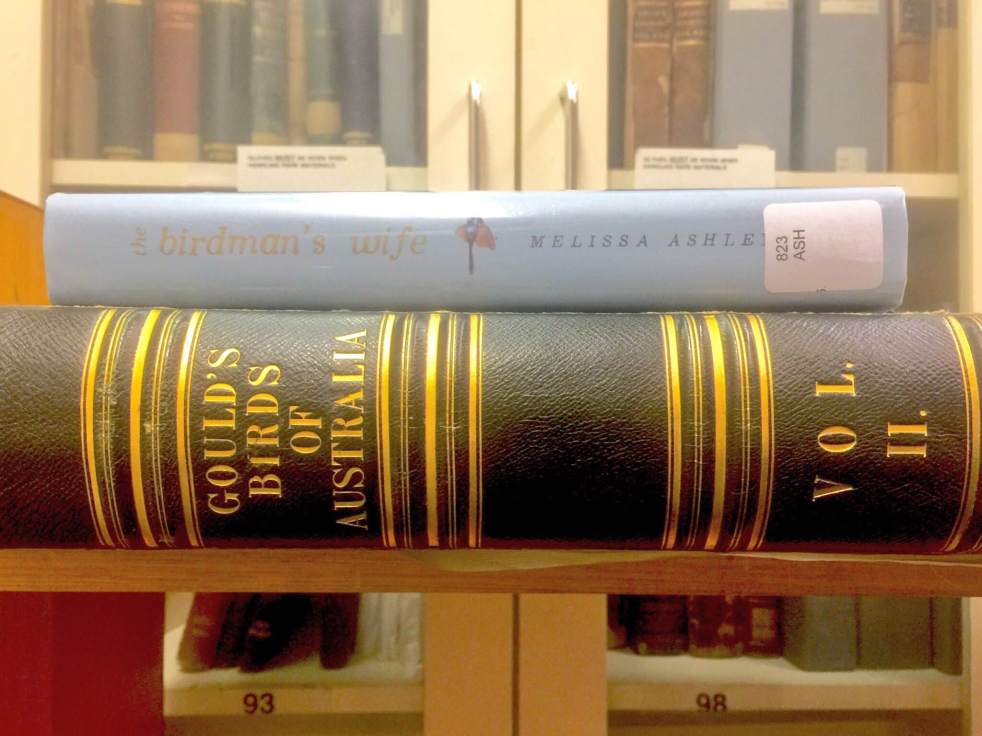
The Zoological Vertebrate Library photo by Emma Rusher
I’m excited to be at the Queensland Museum today because it’s here that I discovered a treasure trove of incredible sources that helped me bring to life Elizabeth Gould, the heroine of my book, The Birdman’s Wife. Along with discovering the Museum’s archival materials, my association with the museum led to the opportunity to meet one of Elizabeth Gould’s descendants. So the museum’s a very special place to me.
John Gould, the famous 19th ornithologist, known worldwide as ‘The Birdman’ and ‘The Father of Australian Ornithology,’ is renowned for creating the most sublime hand-coloured lithographs of birds the world has ever seen. But few people know that his wife, Elizabeth Gould, acted as his principal artist during the first 11 years of the family business. It was Elizabeth who created more than 600 of the hand-coloured plates published in his luxury bird folios. Yet her legacy has been overshadowed by her husband’s fame. Not only did John Gould’s name feature as the author of the folios the couple produced, but he co-signed his name to all of Elizabeth’s plates. Hence, today, many people assume he was the artistic genius who brought so many amazing birds to life.
Presenting my talk, photo by Emma Rusher
Although born in the early 1800s, in some ways Elizabeth’s experiences parallel those of women today. She can easily be related to, juggling a successful career, and taking up her roles as wife, business partner and mother to a brood of seven children. She was also a passionate adventurer and, despite her demanding and ambitious husband, came into her own as a successful artist. With great courage, Elizabeth defied the conventions of her time, parting from her three youngest children to join John on a two year expedition, voyaging from England to Australia to collect, study and describe our wonderful bird species.
At a time when the old world was obsessed with discovering and classifying the natural wonders of the new world, Elizabeth was as at its glittering epicentre. She worked alongside legends like Edward Lear and Charles Darwin — who was so impressed by her art works that he invited her to illustrate his famous Galapagos finches.
Yet, it’s only within books celebrating her husband’s life and works that Elizabeth can be found. And she’s usually portrayed as a shadowy figure, an assistant or supportive partner to her husband. At last, in The Birdman’s Wife I can tell her amazing story. While I have written a work of fiction, it is based on meticulous research. A feat that could not have been achieved without the help and dedication of organisations like the Queensland Museum.
Hand-coloured lithograph of grey fantail and text by Kali Napier
Birds have always fascinated me as a writer, which over time, led me to a birdwatching hobby. This in turn created an interest in antique bird drawings and paintings. A friend loaned me a biography of John Gould, and it was within its pages that I first learned of his wife, Elizabeth. Her life gripped a hold of my writer’s imagination, and I started to delve further into her story.
The more I searched, the more I wanted to discover. I decided that my interest in Elizabeth’s extraordinary life would be shared by many readers, and so I enrolled in a PhD in creative writing, and set out to reimagine her as the narrator of the historical fiction, The Birdman’s Wife.
As with any such project, research was the most important first step and I spent months swamped in correspondence, diaries and biographies. But there came a time when I felt the need to connect in a more tactile way with Elizabeth’s world. Along with birdwatching and field trips to Tasmania and the Upper Hunter Valley, where the Goulds’ Australian expedition took them. I visited museums and libraries to view and handle original manuscripts, diaries and hand-painted lithographs. As part of my ‘field’ research, I took a behind-the-scenes tour of the Museum’s animal collections.
Behind-the-scenes at the QLD Museum photo by Cass Moriarty
Curator, Heather Janetski showed me the vertebrate laboratory, where each Wednesday a group of dedicated volunteers gathers to prepare scientific study skins of marsupials and birds. I responded to this novel environment with pricked ears – it was rich ground for my writer’s imagination. At the conclusion of the tour, one of the volunteers challenged me to return the following week and try my hand at making a stuffed birdskin myself. Surprised at the suggestion, I thought about it and realised what a good idea it was, and signed up to become a Wednesday volunteer.
Feather Board, photo by Cass Moriarty
And so I submitted myself to the visceral task of preparing scientific study skins. When I arrived at the lab, I would tie on an apron, don rubber gloves and make my way to the stuffing kit that had been laid out like a fancy dinner setting on the long workbench. Like gleaming cutlery, neatly arranged at my place-setting was a toothbrush, Dacron (more commonly used to stuff mattresses), paper towels, cornflour, clamps, forceps, scalpel and bonecrusher. And the “meal” itself: a ziplock bag containing a thawed specimen dug out of the museum’s storage freezer. Slicing into skin, removing muscle and fat, separating joints and scraping ligaments from bone, with my hands and senses I learned the processes John Gould followed to prepare specimens for Elizabeth to sketch.
Jan, a long-time volunteer at the QLD Museum, working on a whistling duck alongside a jabiru. Photo by Emma Rusher
While removing the ‘meat’ of a barn owl or black-shouldered kite – which was how Gould’s stuffers referred to a specimen’s tissue – I was treated to entertaining stories of volunteers collecting road kill to bring to the museum for preservation, and dramas in the field involving somebody almost falling into a rotting whale carcass washed up on a beach. And, in one of those wonderful little miracles that occur when you least expect it, Jan a long-term volunteer, introduced me to a fellow member of her bookclub, Jenny Crawford, who was married to a descendent of Elizabeth Gould. Jenny and her husband Bruce, who sadly passed away recently, invited me to lunch at their home to share their personal collection of Gouldian treasures with me. They showed me photographs of the homestead ‘Yarrundi’, still standing, where Elizabeth stayed with her brother, Stephen Coxen, and which features so prominently in The Birdman’s Wife. They told me tales about their ancestor, Henry Coxen, who was nicknamed ‘Gammy Coxen,’ because of an injury to his hand, incurred in a shooting accident. Best of all, believing like me, that John Gould had taken his fair share of the limelight, they enthusiastically supported my project of bringing Elizabeth Gould’s life to light.
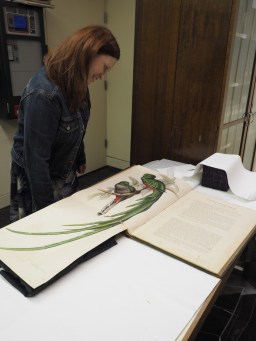
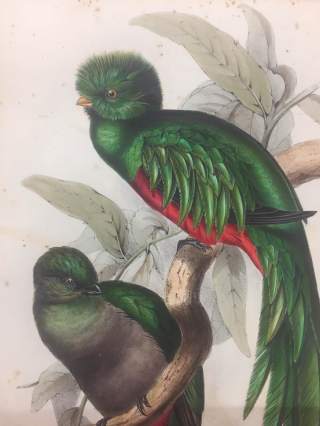
Resplendent Quetzal hand-coloured lithograph QLD Museum library photo by Vikki Lambert
The Queensland Museum’s library treated me to an unforgettable experience of viewing one of their most precious folios. Their rare monograph of the trogan family contains one of the most beautiful hand-coloured lithographs Elizabeth produced, that of the resplendent quetzal. The quetzal forms a key scene in The Birdman’s Wife and also featured in its endpapers. If fact, it is so beautiful, Affirm Press turned it into a bookmark. The lithograph was highly unusual for its time, in that two folio-sized sheets were joined together in order to show off its magnificent tail. As you can see, Elizabeth’s hand-coloured lithograph does full justice to the quetzal’s bizarre, unforgettable form. Along with her incredible drawing, she used a technique of applying powdered metallic dust to the completed watercolour, to capture the iridescence of the quetzal’s plumage when caught in changing light.
In writing The Birdman’s Wife, I enjoyed portraying the exhilaration Elizabeth must have felt creating such a masterpiece. How impatient, how excited she must have been to share her exquisite plate with the bird aficionados who subscribed to the folios the Goulds’ produced.
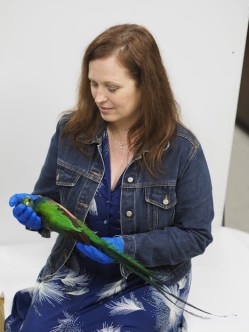
Holding the precious 19th century resplendent quetzal study skin, photo by Vikki Lambert
As an extra treat, Heather Janetski retrieved a precious study skin of the resplendent quetzal from the museum’s zoological collection for me to photograph. The fragile specimen was collected in the 1870s, its faded field tag penned in a careful, flowing script. To prevent insect infestation, 19th century taxidermist’s used a lethal combination of arsenic and lead; thus in handling the skin, I had to wear gloves. I had the oddest sensation cradling the resplendent quetzal specimen, it felt as if I was nursing a days-old infant. Which relates in a lovely way to John Gould’s observation in the text accompanying Elizabeth Gould’s wonderful plate – that male and female quetzals are said to mewl across their forest canopies during mating season, making a sound like a newborn child.
For me, researching and writing Elizabeth Gould’s fictional memoir was a kind of archaeology. I had to uncover enough layers to feel confident to write the narrative of her interior emotional life. Two hundred years of analysis of John Gould and his contributions to ornithology and zoological illustration have created a luminous figure, a colossus even. But time and again, Elizabeth is consigned to his shadow. Biographical descriptions of Elizabeth represent her as her husband’s obedient servant or supportive wife. And, maybe because she lived in Victorian times, all sorts of passive qualities were projected onto the sort of person she might have been: delicate, polite, elegant and deferent. Indeed, a few of John Gould’s biographers’ even suggested that she sacrificed her very life following her husband’s pursuits. Actually, she died in childbirth. Perhaps, more than anything else, in writing The Birdman’s Wife, I set out to overturn these outdated notions. To me, Elizabeth Gould was a woman well-ahead of her time, a person many of us would like to befriend. She was tenacious, courageous, resilient, fiercely loving, talented and adventurous. And it’s high time the spotlight was turned on her adventurous life.
The girls: Many thanks to Cass Moriarty, Kali Napier and Taylor-Jayne Wiltshire for blogging and tweeting the event.
The Birdman’s Wife is a little window into the discovery of Australia’s wonderful birds.
The Booktopia Book Gurus asks Melissa Ashley Ten Terrifying Questions
1. To begin with why don’t you tell us a little bit about yourself – where were you born? Raised? Schooled?
I was born in New Zealand and at 7 years of age moved to Australia with my parents and siblings. We lived in Sydney for a short while, and then moved to Brisbane. I was moved around a lot as a child, attending more than 10 schools, and living in the same number of houses.
I think, in a way, this has helped me as a writer. It’s given me a sense of impermanence and adventure. A deep knowledge that there are many lives to be lived. And to not ever get too comfortable.
I glance back at my freewheeling childhood with a big grin, a wash of guilt and a bit of a shudder.
It was a mad blur of adventure: hanging out unsupervised near waterholes; burning around the neighbourhood on our 10 speed racers and BMX bikes sans helmets and sunscreen; riding go-carts down a street known as ‘killer hill’; jumping from the roof of the lower storey of a friend’s home into the swimming pool. We told ghost stories on the school oval and believed in aliens and spontaneous human combustion. We read Trixie Belden and Sweet Valley High and Judy Blume’s Forever.
Someone was always falling off their bike or skinning their knee – but we just got on with it. A scab or signed cast was a badge of courage, honour, pride.
2. What did you want to be when you were twelve, eighteen and thirty? And why?
When I was twelve I wanted to be a journalist. My lovely father bought me software for our brand-spanking new Commodore 64 computer – The Newsroom I think it was called – with templates and clipart to produce a broadsheet type document. And so I started writing a newspaper for our neighbourhood. It lasted a sum total of two issues and was called ‘The Aussie Informer.’ It was only years later that I cottoned on to why my mother suggested I try a different title.
At eighteen, fascinated by altered states, mysticism and psychosis, I decided my future lay in psychology. (I did some strange reading in grade 12 holed up in my bedroom playing Disintegrationby The Cure over and over.) I completed a double major in psychology as my undergrad degree but after a year volunteering at Lifeline, realised I was not cut out to be a counsellor.
At 30, I came to the end of my short career as a poet. My only book of poetry, The Hospital for Dollswas published around this time. For years I had believed that unless I had my first book out by 30, I was somehow not a REAL writer. But it was at 30 that I decided that fiction was for me. The lines of my poems kept getting longer and longer and suddenly they were blocks of prose. And I hung around too many real and talented poets to kid myself indefinitely. So I unlaced my poetry Doc Martins and began writing my first novel.
3. What strongly held belief did you have at eighteen that you do not have now?
That I knew it all!
4. What were three works of art – book or painting or piece of music, etc – you can now say, had a great effect on you and influenced your own development as a writer?
I love Bernini’s sculpture The Ecstasy of St Teresa; it’s in a little church in Rome. The very cheeky psychoanalyst Jacques Lacan once suggested that the expression on the saint’s face, rather than showing her overtaken by mystical bliss, was actually more mundane: she was having an orgasm. In high school, my artistic sister drew a wonderful detail, in stipple of St Theresa’s thrown-back head, and this made it stick in my mind. Travelling in Rome in my early 20s, I sought out the church in which the sculpture lived and was brought to tears. My love of its beauty has only deepened over the years.
Anne Sexton’s signature poem Her Kind, about being a female writer whose weird talent and uncertain social position makes her identify with witches. ‘I have gone out, a possessed witch’. Anne Sexton was a bewitching woman, drop dead gorgeous, sassy and seductive and I will never forget listening to a recording of her reading Her Kind at the State Library. I was shocked beyond words by her gravelly, cold, nasal voice. Yet what power it conveyed, what experience!
I absolutely adore Ovid’s tale of Apollo and Daphne; Apollo chases the nymph Daphne through the forest, wishing to carry her off. Determined to keep her freedom, Daphne transforms herself into a tree. The motif of the nymph’s fleshy body slowly transformed into bark and leaves, her hands and arms spreading into branches, still weaves through fairy tales, poetry and literature today. I can’t fully explain it, what fate, to become a tree in the woods, but the myth has a magnetic pull on my imagination. I suppose somewhere in my understanding of the archetype, I imagine her throwing off her mantle of leaves and emerging, transformed and powerful, a woman now, in command of herself and untouchable.
5. Considering the innumerable artistic avenues open to you, why did you choose to write a novel?
To be perfectly honest, I think it was some kind of irrational madness. An obsessive determination. AsSamuel Beckett famously observed: I’m simply no good at anything else. I think writing a novel is such an incredible challenge, a journey into the unknown, developing unique relationships with characters and story, it’s agony of course, but such indescribable magic when the scene or chapter you’ve been chasing, trying to wrestle into place, suddenly falls together. There is something mysterious about writing, it’s a lesson I have to learn again and again. It is sort of the key, I suppose. It’s like making beer, or firing ceramic. You have all the ingredients, you make the product, but then in the process or heating or fermenting, a little miracle occurs. You can never tell what the finished chapter or scene will be. And maybe this is what keeps people writing. This is such an incredible reward. Something satisfying between you and the page. So deep, so private, so exhilarating.
6. Please tell us about your latest novel…
John Gould, the famous 19th ornithologist known as ‘The Birdman,’ is renowned for creating the most sublime images of birds from all over the world. But few people know that his wife, Elizabeth Gould, was the artist who drew, illustrated, designed and lithographed more than 600 of the exquisite hand-coloured lithographs he produced. Yet her legacy has been overshadowed by her husband’s fame.
Elizabeth was a woman ahead of her time, juggling her work as an artist with her role as mother to an ever-growing brood of children. She was a passionate and adventurous spirit, defying convention by embarking on a two-year expedition to the Australian colonies with her husband to collect and illustrate our unique birds and plants. At a time when the world was obsessed with discovering natural wonders, Elizabeth was at its epicentre, working alongside legends like Edward Lear and Charles Darwin. The Birdman’s Wife tells her amazing story.
7. What do you hope people take away with them after reading your work?
A sense of delight and fascination – for the extraordinary woman Elizabeth was and the contribution she made by bringing to life the beauty of birds that people had never seen before – and a love of birds! A little window into the discovery of Australia’s wonderful birds.
John Gould
Elizabeth Gould
8. Whom do you most admire in the realm of writing and why?
It’s hard to narrow it down to one particular person. I admire writers like Stephen King and Joyce Carol Oates and Neil Gaiman who are incredibly prolific and productive. Envy really. But the writers I think I most love, are those whose imaginative worlds are rich and unique, a newly discovered planet, and life on these unique places stays with me for years and years.
Two of my favourite authors weave fairy tales into their novels: the late Angela Carter, author of The Bloody Chamber; and the wonderful A. S. Byatt, author of Possession.
9. Many artists set themselves very ambitious goals. What are yours?
I always worry about time. I’m in my forties, so I better get cracking. I would love to write a novel every three years. To publish more wonderful stories about fascinating characters. At present I’m entranced by historical fiction. But I love contemporary literature too, so who knows where the future will lead. There’s a memoir in me, I hope, I have the story, but I’m saving it for later down the track. Ah, carried away just thinking about it!
10. What advice do you give aspiring writers?
Don’t worry about your ‘natural talents’. Try not to think about time overly much. I have come to believe that one of the most important qualities of a writer is patience. Whether emerging or developed, the need for it never goes away. Keep trying, keep learning. Embrace criticism and feedback. Keep reading! At the end of the day, becoming a writer, continuing to write, making it a career, is about putting yourself forward, about not giving up. Tenacity. Determination. And lots and lots of writing and revising.
Photo by Vikki Lambert, excited and a little fluttery.
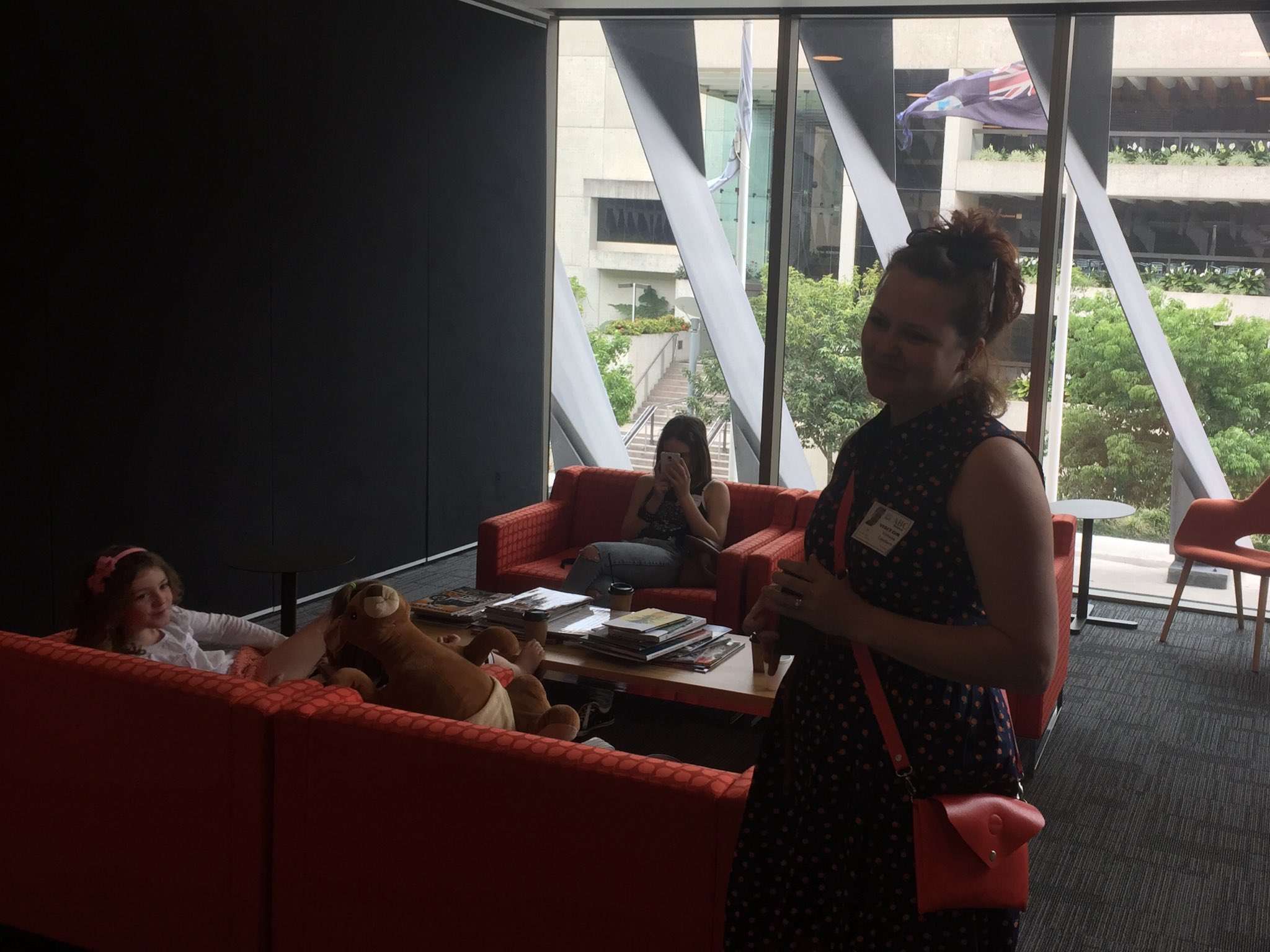
On Sunday, October 9, I was invited by ABC Radio’s Rebecca Levingston to speak on her program Brisbane Weekends. It was a little nerve-wracking, being my first live interview for radio. I had a wonderful support squad, Emma Rusher, Vikki Lambert, Sylvie Dionysius (my daughter) and the lovely Harriet and Camille (who took a few selfies with the Bananas in Pyjamas).
For some time I’ve been listening to interviewees on radio shows, in particular Ratio National, with great attention to voice and process. I think I went okay, at the end of everything, the lovely producer gave me a bottle of water, and we chatted about Donald Trump – a great way to distract one’s nerves.
Rebecca and I had a great chat about taxidermy, A.S. Byatt, poetry, and historical research.
I survived, apart from one or two too many ‘ums’ – I will have to practise an intelligent pause for the future – but all in all it was an exciting experience. We had a debrief with lunch and coffee afterwards in a cafe on Grey Street, South Brisbane.
Photo by Emma Rusher, mums and kids in the green room.
Thanks to the awesome Emma Rusher at House of Rusher for making it happen, to my champion supporter Vikki Lambert and her sweet family, and of course, the wonderful team at the ABC.
You can listen to the podcast of the interview here:
Detail rich, and perhaps rather heavy at times, The Birdman’s Wife is overall a rather compelling read which highlighted the historical tendency for women to be relegated to stand behind their husbands regardless of how much they contributed to his fame. Throughout the novel it is clear that Melissa Ashley’s research is comprehensive and extensive and this extends from her depictions of life in the 1800’s in both London and Australia, life as a woman, wife, and mother during these times, the discoveries made by husband John Gould, and Elizabeth’s life as a professional illustrator and wildlife pioneer in what was essentially a man’s world.
A fascinating read that will endear itself to those interested in historical fiction, issues faced by women historically (arguably still today), ornithology, and the creative arts.
A simply stunning debut novel from a novelist, who given how little Elizabeth Gould was acknowledged in her lifetime, has posthumously shone the spotlight on Gould celebrating her personal and professional achievements in a touching and considered manner.
What a delight it is to read stories of historical figures passed over by history probably because they were women. An even greater delight when they are told well, as is very much the case with Melissa Ashley’s The Birdman’s Wife.
Elizabeth Gould was indeed a remarkable woman. “Inspired by a letter found tucked inside her famous husband’s papers, The Birdman’s Wife imagines the fascinating inner life of Elizabeth Gould, who was so much more than just the woman behind the man.
Elizabeth was a woman ahead of her time, juggling the demands of her artistic life with her roles as wife, lover and helpmate to a passionate and demanding genius, and as a devoted mother who gave birth to eight children. In a society obsessed with natural history and the discovery of new species, the birdman’s wife was at its glittering epicentre. Her artistry breathed life into hundreds of exotic finds, from her husband’s celebrated collections to Charles Darwin’s famous Galapagos finches.
Fired by Darwin’s discoveries, in 1838 Elizabeth defied convention by joining John on a trailblazing expedition to the untamed wilderness of Van Diemen’s Land and New South Wales to collect and illustrate Australia’s ‘curious’ birdlife.
From a naïve and uncertain young girl to a bold adventurer determined to find her own voice and place in the world, The Birdman’s Wife paints an indelible portrait of an extraordinary woman overlooked by history, until now.”
It is only the hardboiled cynic who won’t fall into this story as though in love, won’t be seduced by the intimate narrative style. Here is a story, articulated in a voice commensurate with the era, of a life acutely observed, the sort of story that seems to flow from the pen, belying the many hours and months if not years of research that went into it. It isn’t easy to breathe life into history in fictionalised form. Too often the reader will sense contrivance, or stumble through an unconvincing scene. It’s a fine balance between fact and narration every step of the way and Ashley pulls it off with aplomb.
This is a work imbued with optimism and hope. There is an almost playful romantic quality at first, as a flirtation between Elizabeth and her soon to be husband evolves, yet the story soon departs from romance, as the practicalities and the tragedies of her life unfold, along with what can only be described her life’s work.
The Birdman’s Wife is a story of passion and depth of thought told with an empathy so deep the reader may look up from time to time to find herself in a room filled with specimens, the floor littered with sketches, and Elizabeth herself seated nearby.
Many thanks to NetGalley and Affirm Press for my review copy.
The spoiler alert in this book review is that it is based on a real-life woman: Elizabeth Gould, the wife of an eminent ornithologist / taxidermist, John Gould. If you look up John Gould, you’ll find his Wikipedia entry, which says, “A bird artist”, describing his monographs as “illustrated by plates that he produced with the assistance of his wife, Elizabeth Gould”.
Further enquiry into Elizabeth’s life yields an Australian Dictionary of Biography entry, written by A.H. Chisholm in 1944: “It would appear that the strain of motherhood, together with the executing of approximately 600 drawings for publications, had sapped her vitality.”
600 drawings? Executing? Not merely assisting? In addition to ‘motherhood’, without explanation that this meant eight births.
Too often I hear (usually from men) that women never did anything in history to write about. What they are generally referring to are those ‘great deeds’ of men who were able to dedicate their lives to and sustain an uninterrupted focus on their area of specialisation. Women’s yearnings were sidelined and their lives circumscribed by multiple childbirth.
A.H. Chisholm wrote a ‘complete’ biography of Elizabeth Gould in 1944. In contrast, Melissa Ashley has written a fictional biography, or biographical fiction, of her in The Birdman’s Wife, which revitalises Elizabeth, colouring in her passions, her struggles, her continual negotiation of the demands of being a working artist and a mother.
This beautifully written novel presents a ‘complete’ picture of a family unit—that one man’s crowning achievements were in fact a family enterprise. John Gould may have been able to strut about like a peacock, but his ‘story’ his more complete when put in context alongside the female of his species, their young, and the materials from which he made his nest.
Early in the novel, approaching her first childbirth, Elizabeth muses:
“I would line the nest for our future collaborations. I was made for foraging. I would gather reeds and sticks, bits of straw and cobweb, mosses and grasses, insect wings and shell particles, torn petals and seed husks, all of which I would weave and press into place. My role for now was to assemble a dwelling in which we might raise our complementary talents. What did it matter if I were the nest-based hen, while John flared his pretty peacock’s tail strutting about Regent’s Park?”
As a work of historical fiction, The Birdman’s Wife does not attempt to make Elizabeth a ‘feisty heroine’ anachronistically questioning the gender inequalities of the day. Instead, her voice feels authentic, and Elizabeth wants to be able to raise a family, make a home, and to draw. But she is conscious that she has ambitions, pushing gently against the gender norms. “By my works, I stood apart. As did Lady Franklin… a woman who, like me, was not following the path society had set out for her, but rather forging her own way.”
Statements by her husband, such as “I have a bird-sketcher of my very own. Trained, talented. And she costs nothing at all” do not have the same effect on her that they would on a modern-day woman. She does not see herself as on a par with Edward Lear, whom her husband employs, rather she is excited at the opportunity for professional development by working alongside the noted lithographer.
Ashley has done Elizabeth Gould a great service for imagining her life within the parameters of what would have been possible in her circumscribed life of multiple childbirth and limited professional opportunities. It is because of these parameters that the reader perceives how incredible it was for Elizabeth to venture with her husband to Australia, making personal sacrifices in leaving the children behind.
This sacrifice is a constant sore spot for Elizabeth, as preoccupied as she is with sketching birds in Australia, bearing more children, raising her eldest, and making friends with Lady Franklin. On more than one occasion she questions: “Did obtaining the one set of observances, for the betterment of natural history, justify the negligence of the everyday milestones reached by my own children?”
This conflict is at the heart of women’s stories, whether historical or contemporary fiction.
“It was an exciting thought that the hen had never been drawn by an illustrator. As if the beauty of the male overwhelmed any interest in the mundane, domestic aspects of the species as a whole. But that was my husband, who never viewed the more spectacular sex in isolation from its mate. John wished to know the behaviour of the entire family, of the larger tribe, and how each individual’s role played out.”
Melissa Ashley’s The Birdman’s Wife, shows how historical fiction can somehow be more ‘complete’ than a biography. As so few women’s lives, inner or outer, have been documented historically, it is critical that fiction enters the interstices of archives, to render in full colour an understanding of the past. That men’s great deeds were interdependent on the women and families around them.
Inspired by a letter found tucked inside her famous husband’s papers, The Birdman’s Wife imagines the fascinating inner life of Elizabeth Gould, who was so much more than just the woman behind the man.
Elizabeth was a woman ahead of her time, juggling the demands of her artistic life with her roles as wife, lover and helpmate to a passionate and demanding genius, and as a devoted mother who gave birth to eight children. In a society obsessed with natural history and the discovery of new species, the birdman’s wife was at its glittering epicentre. Her artistry breathed life into hundreds of exotic finds, from her husband’s celebrated collections to Charles Darwin’s famous Galapagos finches.
Fired by Darwin’s discoveries, in 1838 Elizabeth defied convention by joining John on a trailblazing expedition to the untamed wilderness of Van Diemen’s Land and New South Wales to collect and illustrate Australia’s ‘curious’ birdlife.
From a naïve and uncertain young girl to a bold adventurer determined to find her own voice and place in the world, The Birdman’s Wife paints an indelible portrait of an extraordinary woman overlooked by history, until now. Genre: Historical fiction, faction, literary fiction. MY THOUGHTS:
I requested this title not knowing what to expect. It turns out to be faction novel based on the life of nature artist Elizabeth Gould, and told in her own voice. Elizabeth was married to British ornithologist John Gould, and produced hundreds of scientific illustrations for his works, most of which were birds. This novel is not only thick but dense with detail, so don’t start it if you’re not committed. Having said that, here are all my reasons for ranking it 5 stars.
1) The cameo appearances from other famous historical figures of their time are great fun. There’s Edward Lear, shown as a clever, talented young man with a flair for the comical, and Charles Darwin, a celebrated scientist recently returned from his collecting expedition on the HMS Beagle. He inspires John to want to embark on their own, once in a lifetime Australian expedition. There’s Sir John Franklin, the governor of Tasmania, and his powerful and scientific wife Lady Jane, who even leads expeditions of discovery.
2) Elizabeth’s voice always comes across like that of a nineteenth century woman. She notices the things they’d notice, and doesn’t notice things a more modern woman might. This shows how deeply immersed in her character the twenty-first century author must have been while writing it.
3) The husband/wife partnership is interesting to read, and their essential character differences are highlighted. John is depicted with a good natured manner, yet he’s still a driven fanatic, and taxing task master to his staff of helpers, including his wife. Elizabeth is kind hearted and endlessly grapples with guilt about having to kill birds and animals in the name of science. ‘Few creatures were spared my husband’s ambition.’ She also admits that even though she’s a woman of science, she still enjoys what she calls the ‘myths of unenlightened men’ including stories, legends, folklore and symbols.
4) It’s good to learn the difficulties and expenses nineteenth century artists faced, so we can give them the respect they deserve. Elizabeth used all sorts of rare and wonderful ingredients to make her palette mixes accurate, including the imported urine of Brahmin cows which had been fed special mango leaves. Seriously!
5) The pages of notes by Melissa Ashley at the end shows how this project became her consuming passion. She was already an avid birder, but set herself the task of learning the different, complex art techniques and lithography, to help bring Elizabeth’s voice to life. She even became a volunteer trainee taxidermist, to add authenticity. That’s commitment!
6) I recorded heaps of quotes, but will choose to share just this one, about our passions and how the things we spend our days doing end up becoming our identity. Elizabeth said, ‘I painted, I studied, and in this constant striving, became me.’ Although she died sadly young, it can be argued that she’d lived a fuller life than many ladies in their eighties or nineties. Also, I’ve got to appreciate the way Melissa Ashley gave a voice to this remarkable lady whose name had been eclipsed by her husband’s fame for over a century.
7) One of my favourite features of this book is that it helped cure my own wanderlust and discontentment. The Goulds sacrificed so much to travel to Australia, a journey many thought they were mad to undertake. Elizabeth’s maternal heartstrings were torn when she had to leave her three younger children with relatives for two years, since the gruelling voyage would likely have proven too taxing for them. Yet when they arrived in Australia, their wonder and delight with the flora and fauna which is so familiar to me is described brilliantly. Nowhere else in the world is like it, and I don’t have to go through all they did to appreciate it, since I’m already down here.
The chapters in the story are all named after the different birds that surround me each day. Superb fairy wrens, sulphur crested cockatoos, red wattlebirds, willy wagtails, honey eaters, zebra finches, Major Mitchell cockatoos, just to name a few. There’s some touching reminders that the nation must remain poles apart from the rest of the world. On the way back, the Goulds’ healthy specimens perished in transit, including kangaroos, wombats, koalas and possums, as well as birds. Once again, what a wonderful ecosystem we Aussies get to enjoy. I wouldn’t have expected a novel named ‘The Birdman’s Wife’ to give my patriotism a boost, but that’s just what it did.
Thanks to Simon and Schuster (Australia) and NetGalley for my review copy.
Note: I got this book as a netgalley advance copy and I’m exceedingly grateful for that.
Some of the books I get as advanced reading copies are nice. Some I can’t bear to finish. Some, I can’t put down and I want to shout about them from the rooftops. The Birdman’s Wife is one of the latter.
So while I know who the Goulds were, I have no more than a passing interest in ornithology and have never looked at their works. After reading this, I went and googled the lithographs and they are just as exquisite as the novel makes them sound. If you’re not a bird-lover, this book will make you interested in them. If you are, I imagine this book will absolutely enchant you.
It’s the story of Elizabeth Gould, a governess who meets and soon marries ornithologist John Gould, a curator and preserver at the Zoological Association of London. In 1830, John starts on a project to catalog and publish a collection of bird specimens from the Himalayas and Elizabeth agrees to do the illustration. After another four works (and six children, two of whom sadly don’t survive), Elizabeth, John and their eldest child Henry join Elizabeth’s brothers in Australia where they study and collect the local wildlife. Back in London two years (and another child) later, Elizabeth works on ‘Birds of Australia’, an epic work of 600 lithographic plates. This contribution to ornithology (including 328 new species) is what the Gould’s are most know for. Elizabeth then unfortunately dies of childbed fever shortly after the birth of her 8th child, in 1841.
That’s the basic premise of the book and outlined as such, looks stiff and boring.
Luckily, the prose is gorgeous, the flow fast paced and eager and the characters beautifully rendered. Ashley has done an amazing job of getting the reader to dive deep into Elizabeth’s world – not only do you go on her journeys with her, but you do so as an intimate friend. I felt like I was immersed in her life, following along as if Elizabeth herself was talking to me over tea (or a nice port), and the tragic ending caught me a little off guard.
But it’s not just a wonderfully written and easy to read story – it’s a very well researched work, with impeccable science to back it up. Ashley wrote the novel for her PhD, and spent four years doing the work, including becoming a volunteer taxidermist and avid birdwatcher. Science doesn’t make the book boring, instead it enriches it. I knew this was a first novel when I requested it, but Ashley writes as a master (which she indeed is, having received several awards and scholarships for her prose) and effortlessly integrates her research with her storytelling. She is currently (according to her website) researching a book on the “scandalously audacious life of a seventeenth-century French fairy tale writer” which I’m sure will be every bit as delicious as her debut.
I loved the setting of this book, early to mid 19th century Britain and Australia, and I loved even more when birds were mentioned that I knew about. I loved the diary style writing, including the daily ephemera of every day life and conversations with her husband. I loved that Ashley delves into the process of artwork, the vagaries of the muse and the excitement of new technology. I loved the dilemma of leaving her children behind, which is heartwrenching and real and beautifully written. I didn’t love that the book starts when she meets Gould, as I see that as taking some of Elizabeth’s extraordinary personhood away (although, it is called the Birdman’s Wife, so I guess it makes sense to start when she becomes that). I didn’t love that the book wasn’t a million pages longer (although I see the need to keep it under 400 pages). Also, goddammit, I didn’t love that she up and dies. It’s actually quite devastating, which shows Ashley’s skill as a writer – not only do you enter the world of the Gould’s, but you become friendly with them. You forgive John his never ending drive, seeing it as passion. You think fondly of Mary and Daisy, their devotion to Elizabeth. You look forward to seeing the children blossom and grow. And you come to love Elizabeth as a cherished friend, one whose untimely passing is deeply mourned.
To write a book based so heavily in a narrow branch of natural sciences where you still fall in love with the characters is surely the sign of an accomplished and amazing author – Melissa Ashley is certainly that.
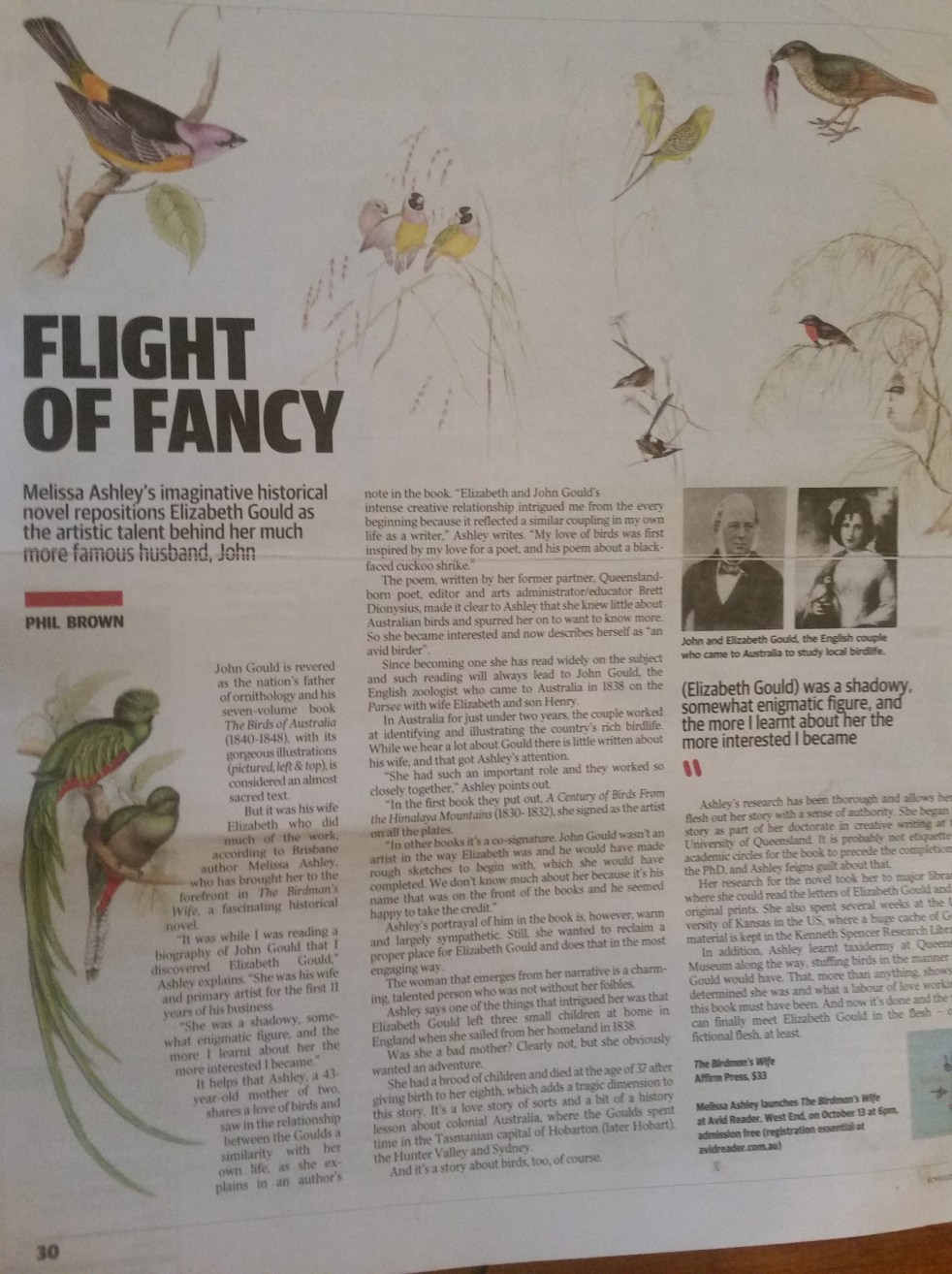
Melissa Ashley’s imaginative historical novel repositions Elizabeth Gould as the artistic talent behind her much more famous husband, John
Phil Brown “Books” QWeekend, 1 October, 2016
John Gould is revered as the nation’s father of ornithology and his seven-volume book The Birds of Australia (1840-1848), with its gorgeous illustrations, is considered an almost sacred text.
But it was his wife Elizabeth who did much of the work, according to Brisbane author Melissa Ashley, who has brought her to the forefront in The Birdman’s Wife, a fascinating historical novel.
“It was while I was reading a biography of John Gould that I discovered Elizabeth Gould,” Ashley explains. “She was his wife and primary artist for the first 11 years of his business.
“She was a shadowy, somewhat enigmatic figure, and the more I learnt about her, the more interested I became.”
It helps that Ashley, a 43-year-old mother of two, shares a love of birds and saw in the relationship between the Goulds a similarity with her own life, as she explains in an author’s note in the book. “Elizabeth and John Gould’s intense creative relationship intrigued me from the very beginning because it reflected a similar coupling in my own life as a writer,” Ashley writes. “My love of birds was first inspired by my love for a poet, and his poem about a black-faced cuckoo shrike.”
The poem, written by her former partner, Queensland-born poet, editor and arts administrator/educator Brett Dionysius, made it clear to Ashley that she knew little about Australian birds and spurred her on to want to know more. So she became interested and now describes herself as an “avid birder.”
Since becoming one she has read widely on the subject and such reading will always lead to John Gould, the English zoologist who came to Australia in 1838 on the Parsee with wife Elizabeth and son Henry.
In Australia for under two years, the couple worked at identifying and illustrating the country’s rich birdlife. While we hear a lot about Gould there is little written about his wife, and that got Ashley’s attention.
“She had such an important role and they worked so closely together,” Ashley points out.
“In the first book they put out, A Century of Birds from the Himalaya Mountains (1830-1832), she signed as the artist on all of the plates.
“In other books it’s a co-signature. John wasn’t an artist in the way Elizabeth was and he would have made rough sketches to begin with, which she would have completed. We don’t know how much about her because it’s his name that was on the front of the books and he seemed happy to take the credit.”
Ashley’s portrayal of him in the book is, however, warm and largely sympathetic. Still, she wanted to reclaim a proper place for Elizabeth Gould and does that in the most engaging way.
The woman that emerges from her narrative is a charming, talented person who was not without her foibles.
Ashley says one of the things that intrigued her was that Elizabeth left her three small children at home in England when she sailed from her homeland in 1838.
Was she a bad mother? Clearly not, but she obviously wanted an adventure.
She had a brood of children and died at the age of 37 after giving birth to her eighth, which adds a tragic dimension to this story. It’s a love story of sorts and a bit of a history lesson about colonial Australia, where the Goulds spent time in the Tasmanian capital of Hobarton (later Hobart), the Hunter Valley and Sydney.
And it’s a story about birds, too, of course.
Ashley’s research has been thorough and allows her to flesh out her story with a sense of authority. She began the story as part of her doctorate in creative writing at the University of Queensland. It is probably not etiquette in academic circles for the book to precede the completion of her PhD, and Ashley feigns guilt about that.
Her research for the novel took her to major libraries where she could read the letters of Elizabeth Gould and see original prints. She also spent several weeks at the University of Kansas in the US, where a huge cache of Gould material is kept in the Kenneth Spencer Research Library.
In addition, Ashley learnt taxidermy at the Queensland Museum along the way, stuffing birds in the manner that John Gould would have. That, more than anything, shows how determined she was and what a labour of love working on this book must have been. And now it’s done and the world can finally meet Elizabeth Gould in the flesh – or the fictional flesh – at least.
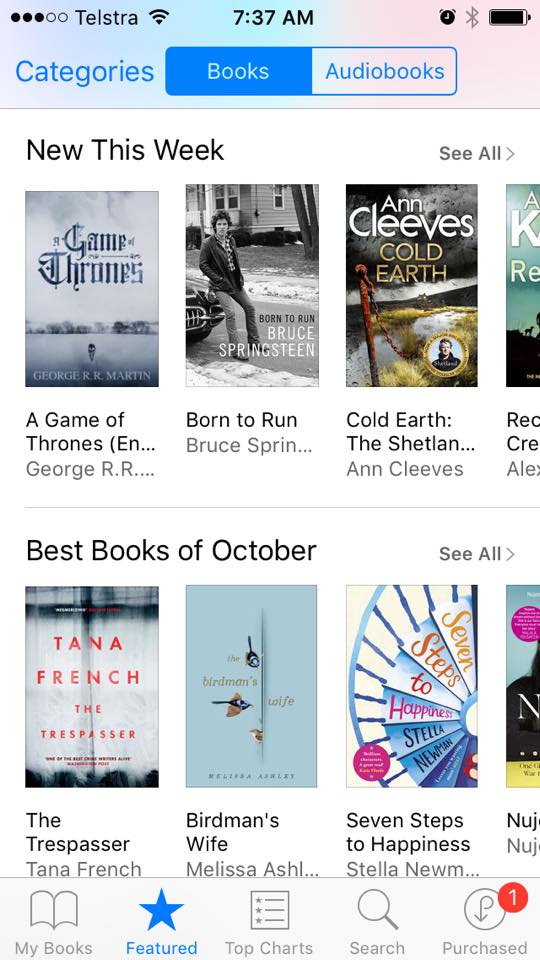
 I’m thrilled, excited and a little stunned that The Birdman’s Wife has made the list of the Best Books of October on Apple’s ibooks feature. The Birdman’s Wife is available as an ebook and can be read on any device. Go ibooks! And thank you.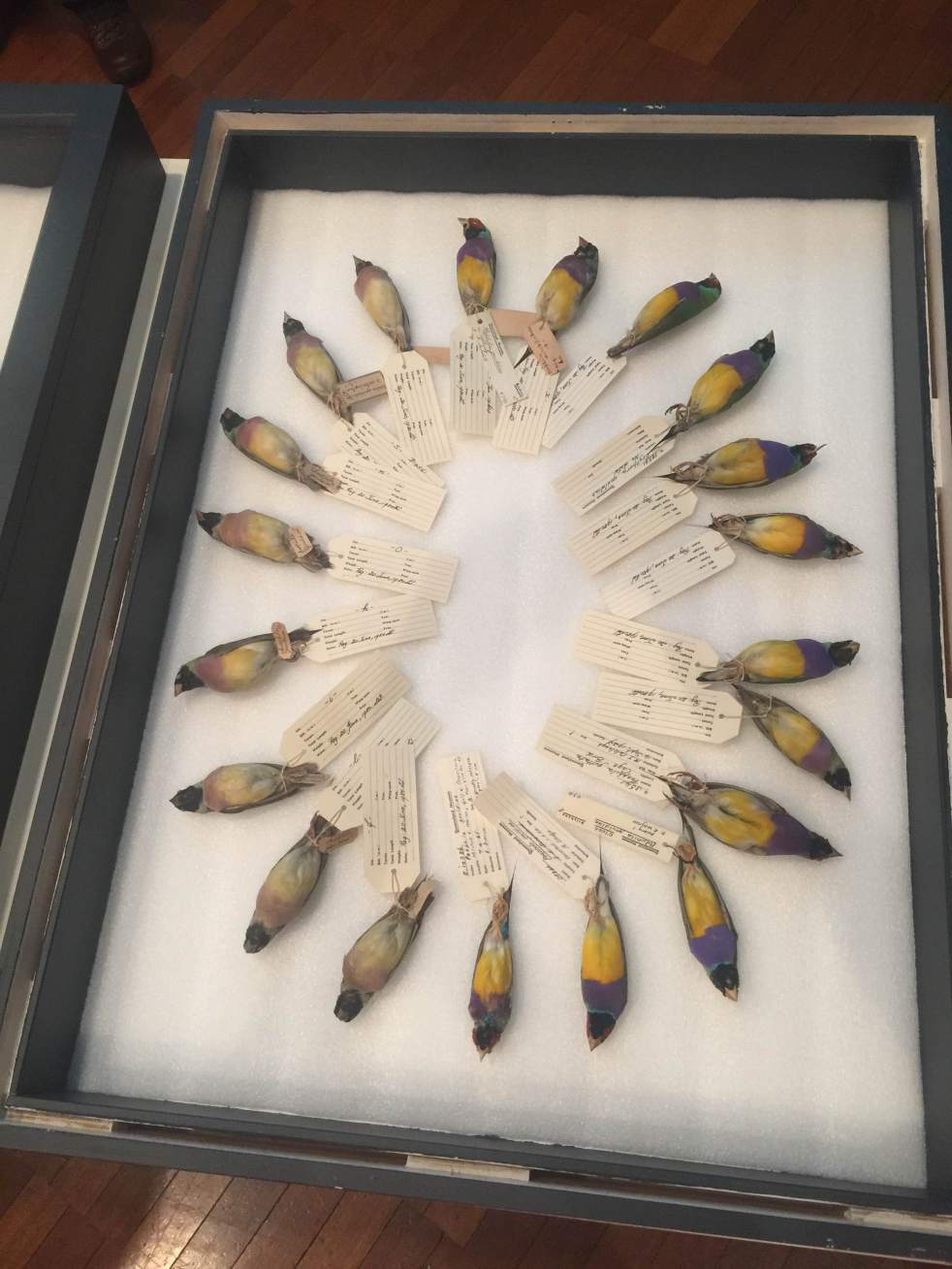








 The spoiler alert in this book review is that it is based on a real-life woman: Elizabeth Gould, the wife of an eminent ornithologist / taxidermist, John Gould. If you look up John Gould, you’ll find his Wikipedia entry, which says, “A bird artist”, describing his monographs as “illustrated by plates that he produced with the assistance of his wife, Elizabeth Gould”.





 Melissa Ashley