Essay

Books Create Australia: Sign the campaign to save Australian literature by stopping the parallel importation of books

Join Books Create Australia’s campaign to protect literary culture in Australia: our book industry, the livelihood of our authors and our unique Australian stories. Show your support today by signing Books Create Australia’s petition to The Hon. Scott Morrison, MP, to stop the parallel importation of books and save Australian literature.


https://www.facebook.com/pg/Bookscreate/about/?ref=page_internal

Quoted from Books Create Australia’s Facebook page:

“The Australian government has set an agenda to boost competition and encourage innovation by recommending changes to the way books are published that will put the local book publishing industry at risk.

Cheaper books sounds good … but at what cost to writers, culture and jobs? The unproven economic model suggested by the Productivity Commission does not guarantee cheaper books. Is the chance of getting 10% cheaper books worth it?”Key Issues:

1. Term of Copyright: recommended to change from death + 70 years, like the US and UK markets to 15 – 25 years from publication.
— This means anyone can publish a book that is pre-2001 without the person who wrote its involvement. Think Man Book Prize winners, like Peter Carey’s ‘True History of the Kelly Gang’, Tom Keneally’s ‘Schindler’s Ark’ and Stephanie Alexander’s ‘A Cooks Companion’.

2. Parallel Importation Rules: recommended to be abolished.
— Australia would no longer be playing on a level playing field. We would give away intellectual property rights without gaining any reciprocal rights with the world’s biggest book-creating nations – the USA and the UK – that maintain their own home market rights. Holding Australian rights to publish a book is the basis on which publishers invest $120M per annum in our local economy by partnering with and paying authors, hiring staff, printing and marketing books.

3. Fair use: recommend US-style fair use to enable large enterprises, including ISPs and educational institutions to use book content for free, without rewarding creators.
— Would we expect a desk and chair manufacturer to provide furniture for classrooms for free? This change has the potential to destroy Australian education publishing. How will it be viable to produce content?”

#bookscreate ideas
#bookscreate culture
#bookscreate innovation
#bookscreate jobs
#bookscreate futures
#bookscreate Australia


Essay · Interview

Books Plus Radio National: Kate Evans interviews Melissa Ashley about The Birdman’s Wife

I had an in-depth interview with Kate Evans @ Books Plus and Books + Arts, Radio National about Elizabeth Gould and The Birdman’s Wife. The interview will be broadcast in the coming weeks on Books + Arts.

Click on the link below to download the podcast or listen online:

http://www.abc.net.au/radionational/programs/booksplus/melissa-ashley-story-of-elizabeth-gould-the-birdman’s-wife/8017164

Articles · Essay

Audiobooks return the pleasures of reading to the print and visually impaired

410yemhlgal-_sl300_Not long after I sold the rights for The Birdman’s Wife to Affirm Press, I was delighted to be offered a publishing contract from Wavesound, a new audiobook imprint dedicated to making Australian titles available in alternative formats to print. Wavesound is an imprint of Audible, the world’s largest publisher of audiobooks. All of Wavesound’s audiobooks are recorded locally in Sydney, and employ Australian actors.
While readers may be aware of audiobooks as a new form of media by which to enjoy reading, few realise that for the print-impaired, audiobooks are the only means of accessing our culturally significant local and national stories.

At the age of 10, my 12 year old daughter was diagnosed with cone-rod dystrophy, a degenerative retinal condition that affects both her central and peripheral vision. Diseases of central vision, known as macular dystrophies in children, and macular degeneration in adults, make reading particularly difficult, as the fine focus needed to engage with print is severely degraded. For some, larger print titles are the answer, but for many, with significant central vision damage like my daughter, the only way to access written texts is via an audio channel. (If she does try to read very large text, it is by scanning words with her peripheral vision. This causes headaches and dizziness, which as you can imagine, destroys all pleasure of losing oneself in the imaginary world of a book.)

Unfortunately, there is a world-wide poverty in accessing audio books for the visually impaired. Indeed, only 5% of texts make it into audio formats. For my daughter, this means that contemporary literature by Australian authors suitable for her age group is often not available. For example, she cannot always access class texts in a suitable format, and instead has them read out to her by classmates or her teacher. My daughter is and always has been an avid reader. She is currently making her way through Anne of Green Gables. She has read Harry Potter several times over and is keen to begin The Lord of the Rings, but there many  recently published titles that her friends enjoy that she simply cannot access. And this is why an imprint like Wavesound’s commitment to publishing unique Australian stories in audio formats is so important.

The audiobook of The Birdman’s Wife was published in the same week that the printed text was released. With Wavesound and other imprints, there is no lag – determined by market popularity, for instance – in accessing an audio title. For the print-impaired reader, this means that having the same diverse choices as any other reader to engage with culturally relevant local and national stories is made possible.

Another bonus to able and impaired readers is that while you can purchase your own copy of an audiobook to listen to at your leisure,  you can also access audiobooks on a downloadable format from your council library – far more convenient than popping into the physical version to borrow the printed title.

I am filled with gratitude that Wavesound has taken the step of making The Birdman’s Wife into an audiobook. Natasha Beaumont’s beautiful narration gives a very different reading experience, rich, lush and nuanced, which can be enjoyed by all readers, not just the print-able. Although my daughter is a little young to connect with The Birdman’s Wife, I look forward to the day when she tells me that she is ready to read the novel I dedicated to her.

To hear a sample of Natasha Beaumont’s gorgeous narration of The Birdman’s Wife, follow the link below (it will take you to the audible website). Enjoy!

http://www.audible.com.au/pd/Fiction/The-Birdmans-Wife-Audiobook/B01M1SETYE


Essay

Australian bird artist Frank T. Morris paints Elizabeth Gould

001

Thanks to Phil Brown’s fantastic article about The Birdman’s Wife and Elizabeth and John Gould in last weekend’s QWeekend, I was contacted by renowned Australian bird artist, Frank T Morris. I was excited to learn that he completely agreed with me that John Gould had taken some (most?) of the limelight from Elizabeth Gould – I like to call him a shameless self-promoter – and that she deserved much greater recognition and respect than she has so far been given. Frank writes :
To my mind the final snub to her and her efforts was his naming of the Gouldian Finch. He claimed to the Royal Society that he named the bird in honour of his wife, but if he was for real he would have called it Elizabeth Finch, not Gouldian Finch. I think his ego was too big to truly honour her.
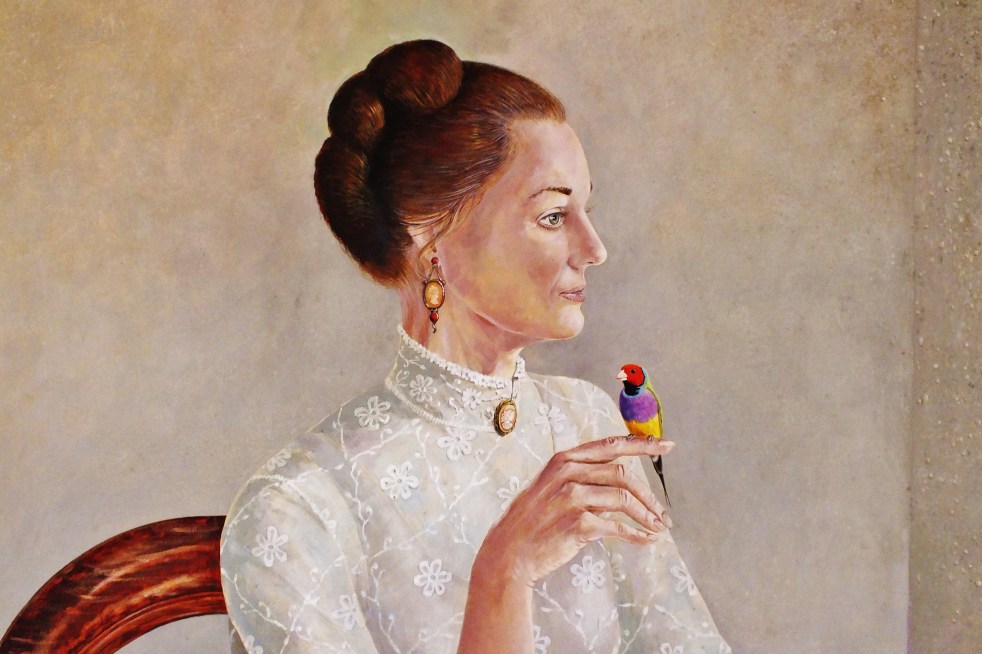
In his frustration and great love of Elizabeth’s artworks, he painted this wonderful portrait of Elizabeth Gould in 1986. The Gouldian Finch, which John Gould said was the most beautiful bird in the world, is perched on her finger. She sits at a table reading a letter John Gould wrote to her, explaining that he had named the Gouldian Finch in her honour. What I find so beautiful about the painting and the concept behind it is that the letter is one of the imagination. Elizabeth never knew that John named this stunning Australian finch to celebrate her passionate dedication to designing, drawing and painting exquisite hand-coloured bird plates, not to mention bearing his eight children and making the sacrifice of leaving three of them behind in England to accompany him to Australia to draw  and collect our ‘curious’ bird species.
Frank is not the only person who has come out ‘to bat’ for Elizabeth. During my research to write The Birdman’s Wife, I met one of Elizabeth Gould’s descendants, who lived in Brisbane. The sadly deceased Bruce Crawford, and three other members of the Coxen (Elizabeth’s maiden name) tribe came to a small presentation I gave about Elizabeth Gould and my research. Similarly, the family were very enthusiastic about my Elizabeth Gould novel project (as it was at the time). Their support, along with Frank’s, means so much to me.
Long live Elizabeth Gould’s glorious hand-coloured lithographs.
You can see more of Frank T. Morris’s beautiful bird paintings at franktmorrisart.com.au.
Essay · Uncategorised

Merchandise!

On Friday I received the fantastic news that The Birdman’s Wife has come back from the printer. A copy for me has been express posted to my address, due to arrive either Monday or Tuesday. All writers know the excitement of waiting for their contributor’s copies to turn up–dented, rain-damaged, flawless–listening out for the postie, trying not to be distracted beavering away on a new project. Grants, offers, cheques, contracts, they all arrive via post. When I was younger, notification of publication or rejection was received by snail mail too, and I became unconsciously tuned to the red and fluoro yellow flash of the postie. I knew I was being productive when I was listening out all the time. It always feels great to have a few pieces circulating.

So of course, today, amongst various jobs, I had an ear out. The postie came by at 12.30 to deliver a bank statement and some propaganda from the council. Disappointed but not surprised, I went back to marking. What would you know, but half an hour later, a second postie bike flashed by and then stopped, idling before the postbox, digging about in his panniers. This time a parcel was left behind.

The gods had smiled on me! I waited until he was out of sight and then closed the computer and straightened my dress. No matter what, I said to myself, you’ll remember this moment forever. Are you ready? My stomach flipped as I opened the door, no doubt whatsoever in my mind that my book was here. What would it look like? Would it be all I had dreamed of and more? Should I take a photo of the unopened packet for posterity?

Just do it, I said to myself. You don’t need to share every-bloody-thing! This one’s for you. 

I opened the letterbox and lifted out a smallish package. Hmmm. Wasn’t it supposed to be a bit bigger? I checked the sender’s address: it was from my publisher. I bent the packet this way and that -my book’s a hardcover- and it flexed! Hmmm.

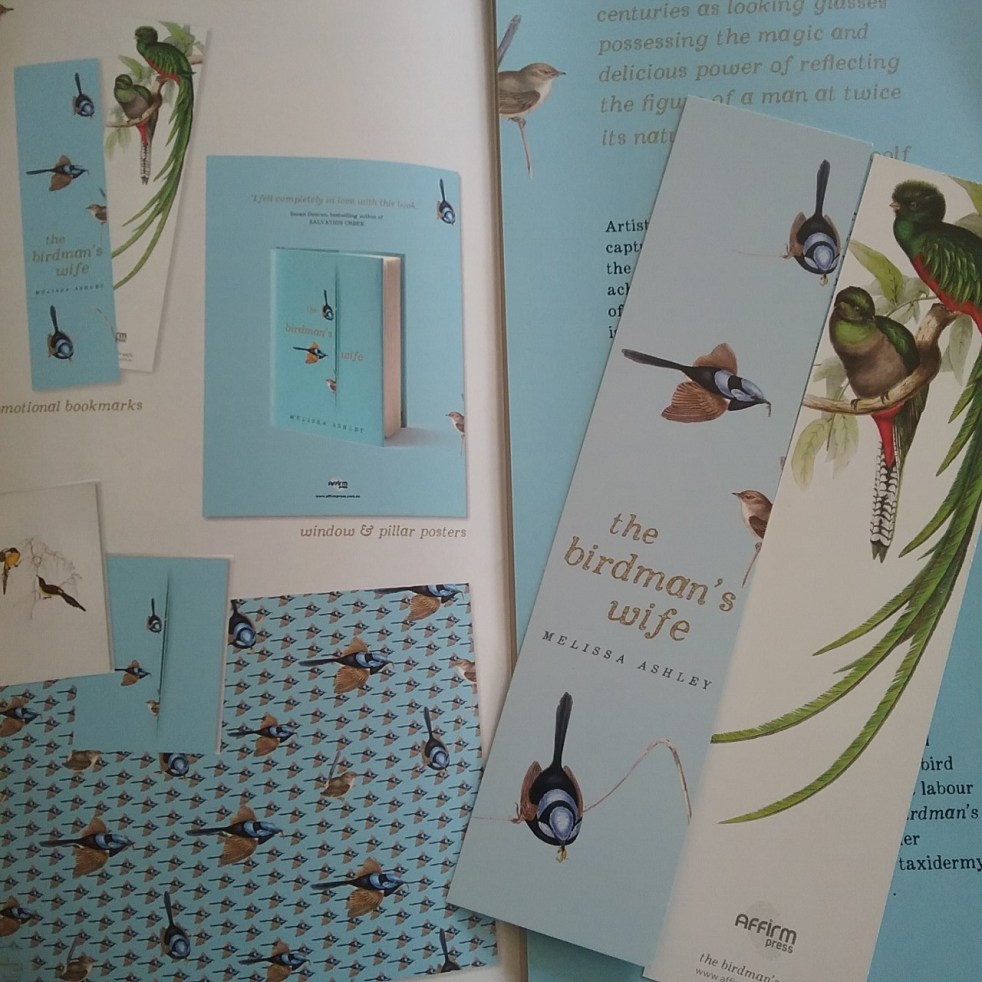
The wait (the second most important trait of a writer) continues. With any luck, The Birdman’s Wife will be in my hot little hands tomorrow. In the meantime, my wonderful publisher has sent me some merchandise to enjoy, which of course I can’t resist sharing.

Essay

“As for me, most days I make an effort to do good.”

MyDarling

“Thanks, for the trouble you took from her eyes, I thought it was there for good, so I never tried.”


My daughter and I always squabble about which music to play during the drive to school. I made her suffer Jeff Buckley’s Hallelujah this morning, tired of repeats of the Hill Top Hoods’ Nosebleed Section. Waving me goodbye, I watched her move off, thinking of friends, swaying from side to side as she walked. I studied her, as I often do. How she looks at me. How she negotiates a sharp curve. Her clinging to me at the shopping centre. Two years ago, we discovered that she is losing her eyesight. She can no longer read, resorting to audio texts to get her through class lessons. To put herself to sleep at night. Like me. But her peripheral vision is still strong enough for her to navigate the familiar grounds of school.

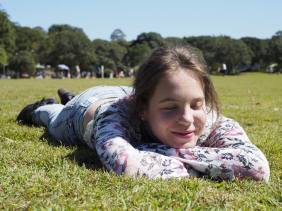
My daughter turned twelve this week, and her enjoyment of the attention lavished upon her has been unexpected. My sisters and brother started their families at the same time, six years after my son was born. My children’s seven cousins are aged from 9 months to 3 years. For the last year or so, whenever our families gathered together, my daughter would disappear into another room or space, lost and confused, unable to speak and interact. At her birthday picnic on Sunday, one of those perfect Brisbane August days, her laughter tinkled out over the river. She lay on her stomach in the grass, eyes closed, enjoying the sun on her hair. She horsed around as her cousins climbed on her back, doing their best to squash her, toppling off.

Driving home this morning, inspired by Buckley, I played Famous Blue Raincoat, realising that, after the two most difficult years of my life, my emotions have settled enough for me to contemplate the future. I have spent so many moments at the steering wheel crying. Eagle-eyeing my daughter through the day, trying to comfort her late at night, swallowed by the immensity of her loss. I could only take it in in pieces. It’s the reflection, the acceptance and regret in Cohen’s song that gets me.

And what can I tell you my brother, my killer
What can I possibly say?
I guess that I miss you, I guess I forgive you
I’m glad you stood in my way

Cohen’s song made me order a novel from overseas, several years ago, by Samantha Harvey. Dear Thief. It was, by far, the best book of that reading year. A story of betrayal inspired by Famous Blue Raincoat.

“I suppose the world is constantly producing things of wonderment, every moment, at every scale, and one time in every million or so our minds will be such that we are open to seeing it. To see the silver effervescing of the dust was as beautiful a sight as any mountain or waterfall; but then, when I saw it, I was in love and as happy as a human being can be. Or course this helped. The world is heavily changed by the way we perceive it; in all my reticence and doubt, this is one thing even I haven’t been able to dispute.”

Samantha Harvey, Dear Thief

Each morning, directed by my psychologist, I am supposed to record my mood, to help gauge if I have to intervene with a bath, meditation, a call to a friend, a walk by the river, it’s a brace to hold me back from falling. My relationship broke down too. It was a long one, and, although I was proud that I could keep going, underneath I was deeply shocked. All I had known and thought secured, had suffered a terrible shift. My son’s home from school today, sick with a hacking cough and high temperature. He needs me. And that’s okay. I can be there for him. I haven’t been anywhere for so long that the return is extraordinary.


Essay

An (almost) unbearable wait

In the lead up to the publication of my first novel, I’ve attempted to keep sane by easing myself every now and again into the murky waters of a new writing project. It hasn’t been easy, in the midst of a tight editing and publicity schedule, to find the necessary mental space to contemplate, let alone begin, the obsessive process of coaxing a new work to life.

13939414_10209838797662694_3557030505103303337_nI’m a slow writer. Fast, when I have the idea sorted out, be it the outline, the chapter, the character sketch, but in the lead up to these flurried bursts of keyboard tapping, there are months, weeks, years – Toni Morrison calls it ‘playing in the dark’ – of uncertainty and unease. The requirement of much patience, of inventive healthy (and no-so much), antidotes to that humming motor of anxiety. What surprises me, over and over, are the number of possibilities for the next big project that need to be sifted through before I can settle upon the one that has all of the required parts.

Because I’m a stickler for research, it takes me at least six months of immersion in a subject before I’m even ready to contemplate plot. Before I start writing, I feel a strong need to take an indefinite holiday or go on wild shopping sprees (I hate shopping). And, once I have completed a draft, I need nine months’ or so of a break – teaching, catching up on contemporary novels, daydreaming, being a mum and friend – before building the confidence to return to the raw file.

I have to keep other pieces of writing on the go, to stop losing confidence, to stop mourning the months of scant production. Will I ever write again? Have I forgotten how? I write essays, short stories, once upon a time I wrote poems, but no more, as I pan and filter for the next big project.

Writing’s a funny old beast in that you continually relearn, or is it re-experience? – how it actually works. It’s tricky and slippery, there’s no forcing a chapter or scene when it’s not quite ready, but when that little firefly of readiness appears, all must be put aside to follow its jagged flight.

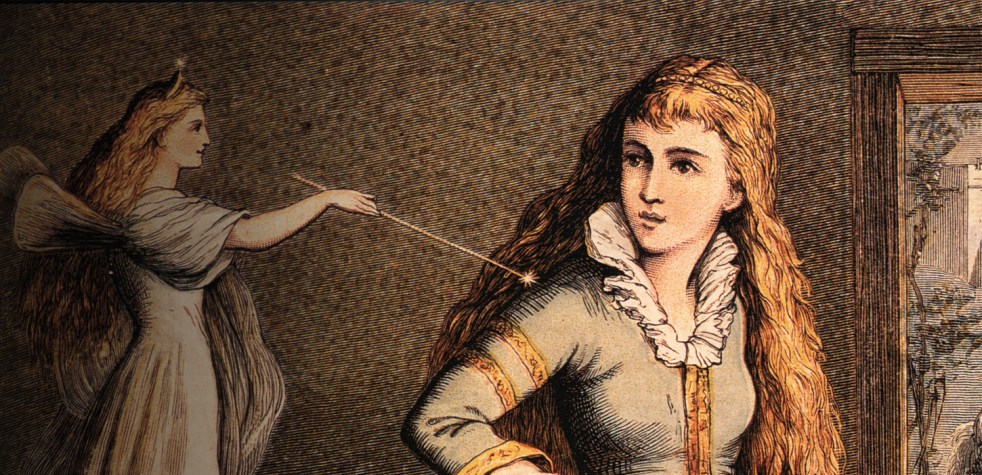
To arrive at a point of confidence in committing to a new project I need to be utterly sure I can sit with the themes, story, setting and characters for several years. In the last four years I’ve contemplated writing a memoir, which I have fully outlined and made copious notes for, an on-the-road contemporary novel about a woman fleeing her life, which I wrote 60,000 words of a draft before deciding not to resuscitate. And, a historical novel I thought about researching before I began the novel I have recently finished. The setting is late 17th century France. The characters are a group of aristocratic women who contributed to the development of the novel, the memoir, the travel narrative, and the literary fairy tale. They were best-sellers in their day, their books translated into other languages, and published in many editions. But in the Enlightenment these women’s extraordinary texts were slowly erased from the canon. Which of course only makes their histories more tantalising, their adventures and narratives more compelling. I’m looking forward finding their pearls and fountains and ogres and spells and oranges and towers and rubies and fairies.

160bcdabb99fe24ca648c273a751d9ca[1][1]I do think the memoir project is a keeper, though not for now. The on-the-road jag is dead to me. But the novel of the Sun King and the Old Regime, keeps flashing in the peripherals of my daily life; as I fall asleep, as I drive, drinking a glass or wine (or two), reading my students’ drafts, such that I’m going to give it a chance. I’m saying yes to its long courtship. For it has everything and more to keep me occupied, entertained. After a long wait, I’m thrilled to be back to my desk, the agony (I do not exaggerate) of midwifing my first novel forgotten, eager to fill in some new blanks.

 

Essay

The Birdman’s Wife

The Birdman’s Wife

Affirm Press, October 2016

ISBN 9781925344998

Pre-order at Simon & Schuster

John Gould created the most magnificent works on birds the world as ever seen. But the celebrated ‘birdman’ had a secret weapon – his artist wife, Elizabeth. Inspired by a diary found tucked inside her famous husband’s papers, The Birdman’s Wife imagines the fascinating inner life of Elizabeth Gould, who was so much more than just the woman behind the man.

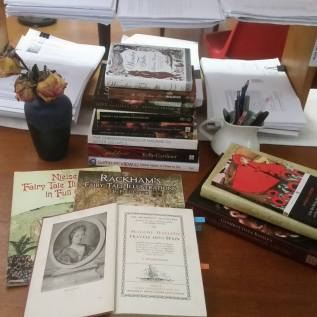
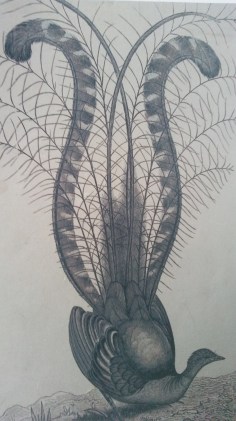
20150419_131909Elizabeth Gould was a woman ahead of her time, juggling the demands of her artistic life with her roles as wife, lover and helpmate to a passionate and demanding genius, and as a devoted mother who gave birth to eight children. In a society obsessed with natural history and the discovery of new species, Elizabeth Gould was at its glittering epicentre. Her artistry breathed life into hundreds of exotic finds, from her husband’s celebrated discoveries to Charles Darwin’s famous Galapagos Finches.

Fired by Darwin’s discoveries, in 1838 Eliza defied convention and her own grave misgivings about leaving all but one of her children behind in London in the care of her mother by joining John on a trailblazing expedition to the untamed wilderness of Van Diemen’s  Land and New South Wales to collect and illustrate Australia’s ‘curious’ birdlife.
From a naive and uncertain young girl to a bold adventurer determined to find her own voice and place in the world, The Birdman’s Wife offers an indelible portrait of an extraordinary woman overlooked by history, until now.

Essay

Sneak Preview: Sumptuous Artwork

The Birdman’s Wife: Artwork

13680652_10209613236663810_644470521026798551_n

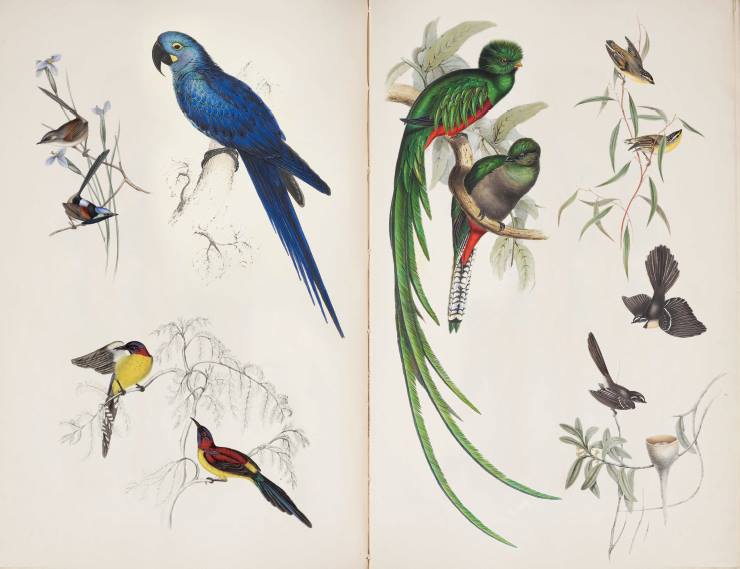
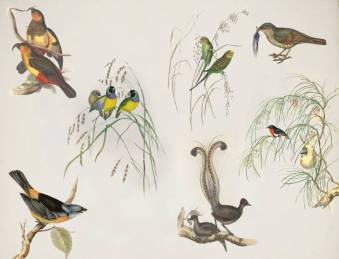
In her eleven year career working as principal artist for her husband John Gould, Elizabeth Gould drew, painted and lithographed some 650 hand-coloured lithographs to illustrate the couple’s magnificent folios, featuring many of the world’s most beautiful bird species. Elizabeth, who was not a professionally trained artist, learned lithography from Edward Lear, who not only invented the limerick but was also one of the greatest natural history illustrators of the time. In discussing Elizabeth’s artworks, I had many requests and suggestions that it would be wonderful to include some of her hand-coloured lithographs in my novel. 13692655_10209613170342152_2518697375758487952_nMy dream for more than a decade, was to have a novel published. I am very fortunate to have signed with Affirm Press, who have worked tirelessly — many, many thanks to Christa Moffett, Karen Cook, Kathryn Lafferty and Fiona Henderson — for all the work you have put into finding, funding and designing these exquisite endpages featuring the artworks of Elizabeth Gould. (The indigo macaw is Edward Lear’s.) I could not be more pleased and excited!


The Birdman’s Wife will be produced in hardcover, the inside cover featuring Elizabeth Gould’s complete hand-coloured lithograph of the superb fairy wrens and their young, which are shown flying out of the front cover on the dust jacket. I can’t wait to have the final copy in my hot little hands! Please enjoy!

Essay

Resplendent Quetzal

“Beak gamboge yellow; head covered with long filamentous plumes forming a rounded crest; from the shoulders spring a number of lance-shaped feathers, which hang gracefully over the wings; from the rump are thrown off several pairs of narrow flowing plumes, the longest of which, in fine adults, measure from three feet to three feet four inches; the others gradually diminishing in length towards the rump, where they again assume the form of the feathers of the back ; these plumes, together with the whole of the upper surface, throat and chest, are of a most resplendent golden green; the breast, belly and vent are of a rich crimson scarlet ; the middle feathers of the tail black ; the six outer ones white for nearly the whole length, their bases being black, feet brown.”

This is John Gould’s description of the resplendent quetzal, taken from the letterpress accompanying his illustration of the species in his Monograph of the Trogons, (1858-1875. second edition). The resplendent quetzal, Pharomachrus mocinno, is a Central American trogon that resides in the region’s remote cloud forests. One of the world’s most stunning birds, it features prominently in Mayan mythology and not only is it Guatemala’s national bird, the country’s local currency also bears its name. The resplendent quetzal’s long tail feathers were a Mayan status symbol, worn only by chiefs and high ranked warriors. Killing or harming a quetzal was said to bring bad luck and for this reason, after special hunters removed its tail feathers, the bird was released back into the wild. Legend has it that the male resplendent quetzal’s breast feathers turned scarlet keeping vigil at the side of a Mayan chief as he bled to death from the attack of a Conquistador.

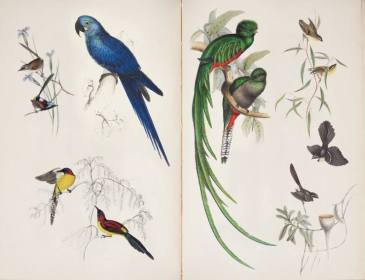
On Thursday I had the pleasure of paying a visit to the Queensland Museum to photograph the resplendent quetzal with my sister, Vikki Lambert, for some of the artwork for The Birdman’s Wife. In 1836 Elizabeth and John Gould created a hand-coloured lithograph of the male and female resplendent quetzal, one of their most stunning plates. The print was highly unusual in that the Goulds joined two folio sheets together in order to fully render the male’s magnificent tail plumage; in a mature adult the tail plumes are three times the length of its body. Elizabeth’s hand-coloured lithograph does full justice to the quetzal’s bizarre, unforgettable form, which of course, is only fitting.

In writing The Birdman’s Wife, I tried to portray the exhilaration Elizabeth Gould must have felt after the plate’s completion. How impatient, how excited she must have been to share her masterpiece with the bird aficionados who subscribed to the folios she produced with her husband. The lithograph was a landmark achievement, unsurpassed in its day – the aesthetic and scientific potential of lithography only really came into its own in 1830, with the publication of Edward Lear’s (of limerick fame) monograph of the parrot family. Elizabeth used a technique of applying powdered metallic dust to the completed watercolour, to capture the iridescence of the quetzal’s plumage when held under light.

Very generously, The Queensland Museum library granted me permission to photograph an original plate, from the Goulds’ Monograph of the Trogonidae, or Family of Trogons  (1835-1838). The monograph, superseded by a second edition in 1858, is extremely rare, with only two copies held in Australian libraries. The resplendent quetzal, notoriously difficult to encounter in its natural habitat, proved a challenge to photograph, requiring many adjustments of position and lighting to adequately render its brilliance. With the patience and assistance of librarian Meg Lloyd, and the the perseverance of my photographer, Vikki, after several hours, we finally succeeded.

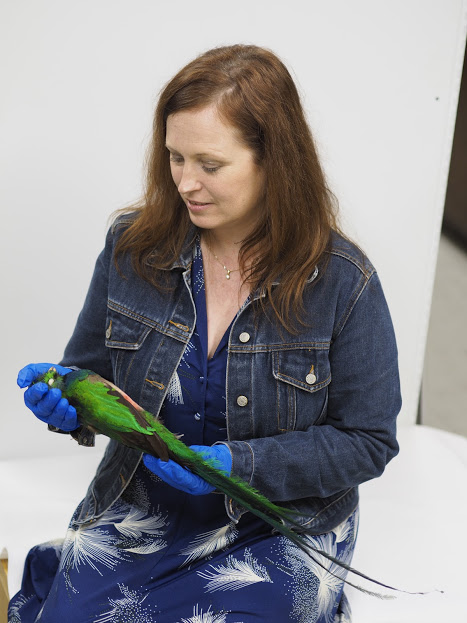
The curator of the museum’s zoology collections, Heather Janetski, retrieved a precious study skin of the resplendent quetzal from the museum’s holdings for us to photograph as well. The specimen was collected in the 1870s, its faded field tag penned in a careful, flowing script. To prevent insect infestation, 19th century ‘stuffers’ used a lethal combination of arsenic and lead; thus in handling the skin, I had to wear gloves. I had the oddest sensation cradling the resplendent quetzal specimen, keeping still for the perfect shot; it felt as if I where nursing a days-old infant. Which relates in a lovely way to John Gould’s observation in the text accompanying Elizabeth Gould’s wonderful plate – male and female quetzals are said to mewl across their forest canopies during mating season, making a sound like a newborn child.